Chess calculation and how to see ahead
Blindfold chess training is a party trick.Calculation isn't.
In a game you stare at the board, never at a blank wall.
Why do I keep blundering in chess?What your calculation leaves out
You train your attacks. You lose to theirs.
Calculate the reply your opponent will actually play
Puzzle lines are defended by an engine. Your opponents aren't.
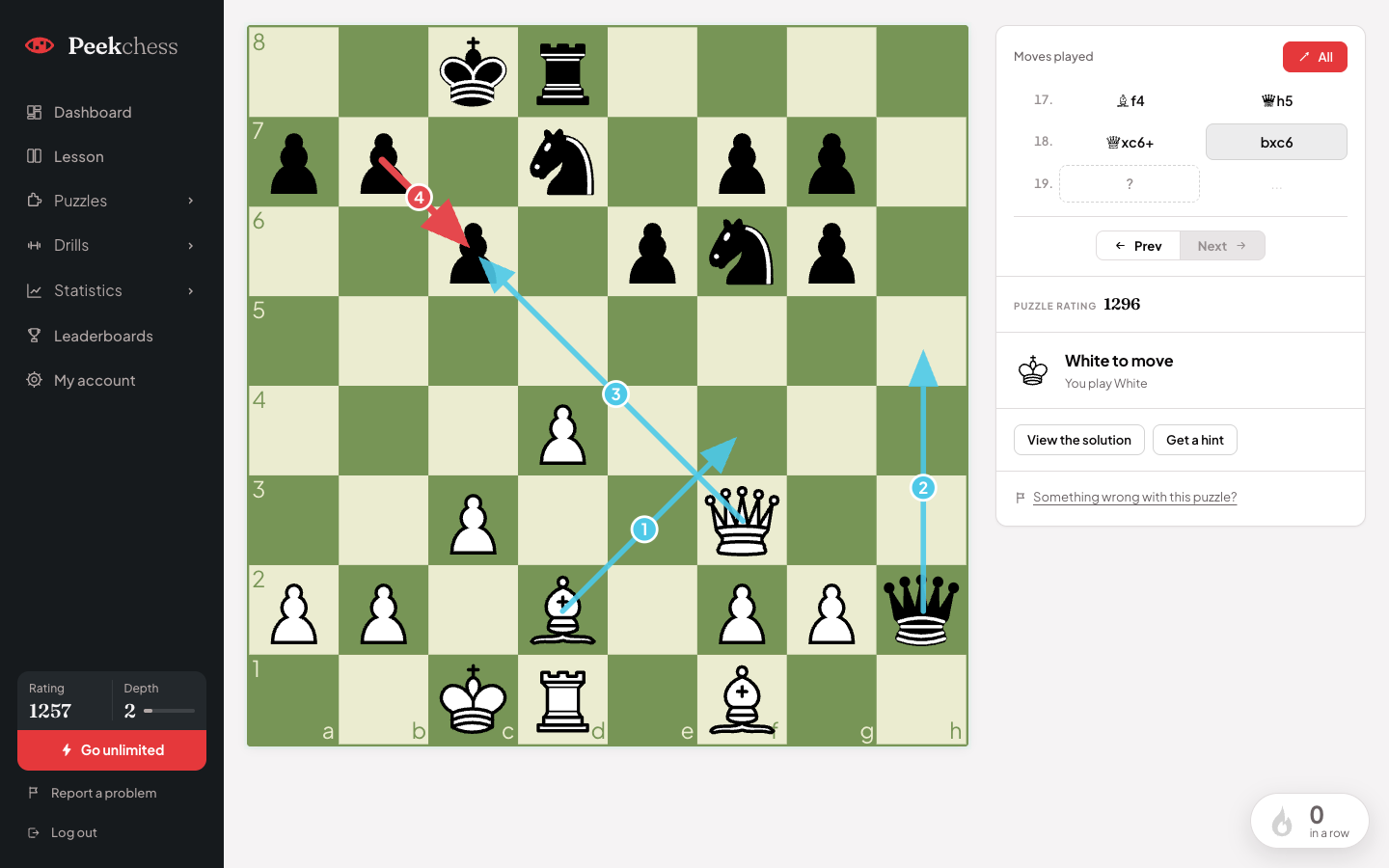
Chess rating plateau?Why your puzzles skip the calculation
Thousands of puzzles, rating stuck? Here's one reason.
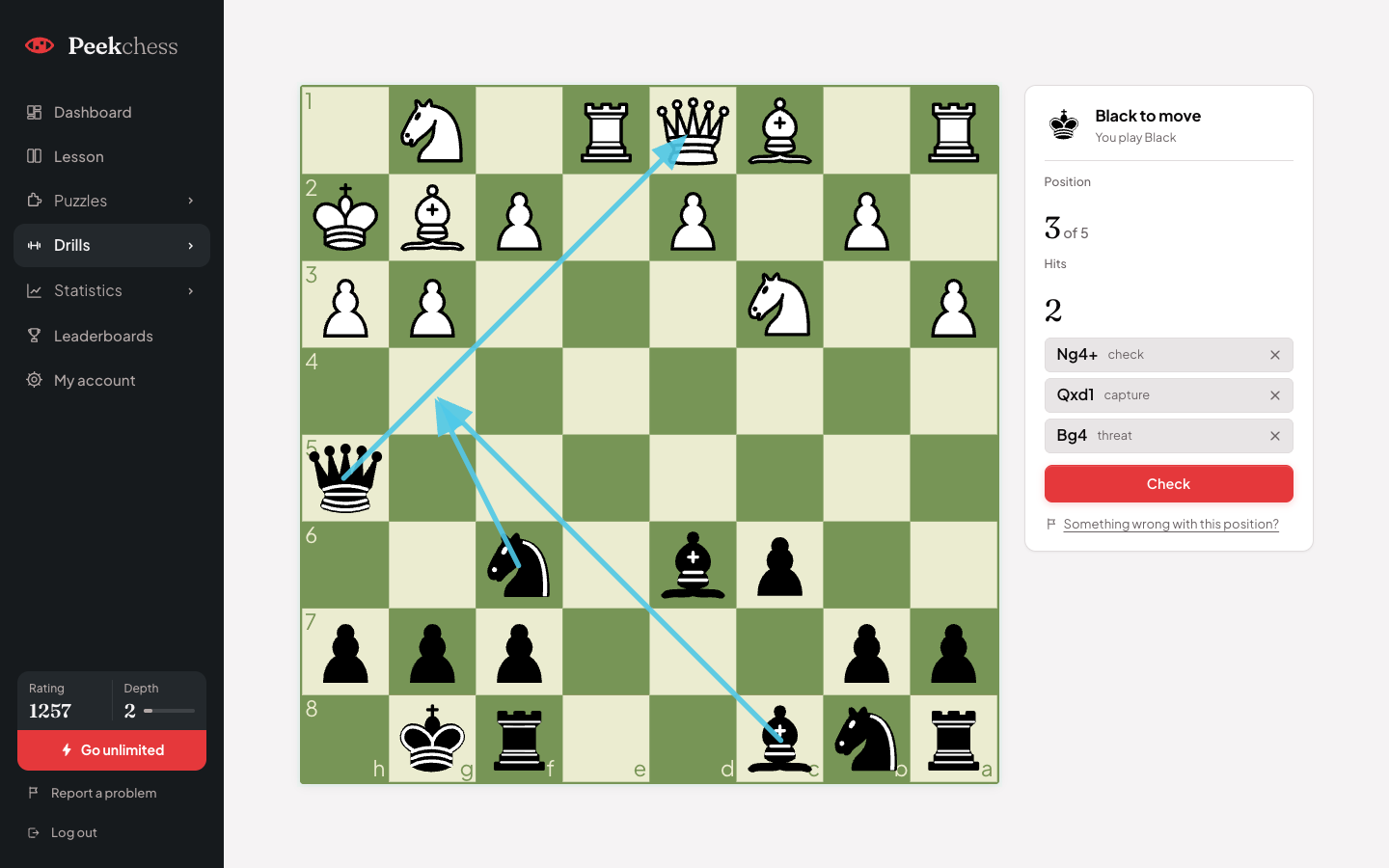
How to stop blundering in chess with three questions before you calculate
Checks, captures, threats, for both sides, before every move.
5 chess visualization exercises that carry over to calculation in games
Two to five minutes each, from square colours to reading a whole line.
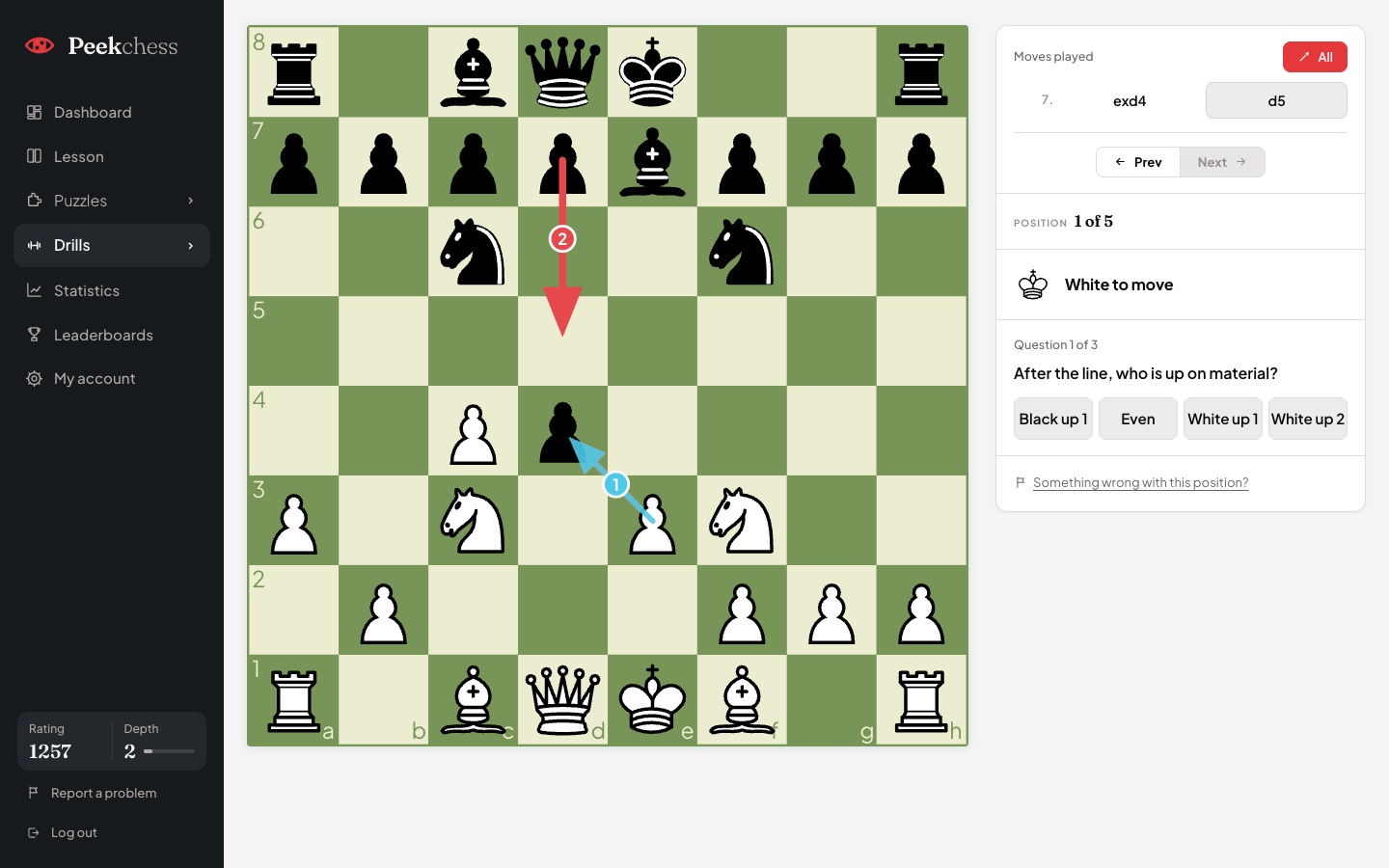
A 7-day routine to improve chess visualization and calculation
Fifteen minutes a day, one move deeper at a time.
What is visualization in chess, and why does calculation depend on it?
Moving the pieces in your head, over the board you can see.
Chess puzzles for beginners to start calculating
Six positions to solve, easiest first, and how to solve them without guessing.
Chess Puzzles Where the Pieces Don't Move
When nothing moves until you've seen the line, a puzzle asks what a game asks.
Chess Puzzles Where You Enter the Whole Line
Commit it all at once, play it move by move on a still board or write it down. Three ways to enter a line, and why both sides' moves matter.
Does the Woodpecker Method train calculation?
You solve one set of puzzles again and again, faster each time. That trains recognition. What it leaves out is calculating a line you have never seen.
Mate in 2, 8 puzzles to calculate
Eight checkmates in two moves, from easiest to hardest, and how to calculate them instead of guessing.
Chess blindness, why you miss a move before you start calculating
A free piece or a mate in one, and you never saw it. Why it happens, and the check to run before you start calculating.
How many moves ahead do chess players think?Chess calculation by rating
Under 1200, 43 of 100 tactic losses needed 2 moves (4 plies) or more to see coming. At 2100 and up, 74 did. What 50,000 games say about calculation.
Do chess puzzles train calculation or just pattern recognition?
If the reply appears on the board, you can solve a puzzle one move at a time, and that mostly trains recognition. Calculation means holding the whole line in your head.
Can adults still improve their chess calculation?
Yes. What changes as an adult is your time and your habits. What to train first, and how long before it shows in your games.
Chess calculation for beginners, how to see more than one move ahead
You don't need to guess what your opponent will play. You need to check their best reply, and that starts with their checks, captures and threats.
Why you lose track of the pieces in a long calculation
A piece you traded off is still part of your plan, or a rook you moved still guards its old square in your head. Why it happens, and the drills that fix it.
Memorize opening lines or train calculation?
In 50,000 games the opening decided 2 of every 100 losses. What's worth learning by heart, what to leave to calculation, and how to split your study time.
When to stop calculating in chess, and where to spend your time
Stop when there's no check, capture or threat left. Spend your time on the moves that can lose to one.
Chess strategies for beginners, 10 rules that win games
Control the centre, develop your pieces, castle early. The ten rules every beginner hears, why each one works, and the mistake that usually goes with it.
Mate in one, 12 puzzles to calculate
Twelve checkmates in one move, from easiest to hardest, and how to make sure a check really is mate before you play it.
Hard chess puzzles to test your calculation
Ten difficult positions, easiest first, and how to calculate a long line without guessing.
Chess tactics puzzles for calculation, one for each main tactic
Twelve puzzles, one for each main tactic from the fork to the sacrifice, and how to calculate them before you move.
Chess quiz, 12 positions to test your calculation
Twelve positions, easy to hard, and seven quick questions, with answers and a score guide that tells you what to train next.
Chess strategy, how to find a plan when there's no tactic
Pawn structure, outposts, good and bad bishops, open files, space, the minority attack and prophylaxis. The ideas that tell you what to do when nothing is forcing.
Peekchess compared for chess calculation





Best Chess Tactics Training Apps 2026
Seven tactics apps, who each one suits, and what it costs.

Best Chess Puzzle Apps 2026
Seven places to solve chess puzzles, and who each one suits.
Best Alternatives to Chess.com Puzzles
Peekchess and five more alternatives to Chess.com puzzles, what each costs, and how each trains calculation.
Best Chessable Alternatives
Peekchess and six other Chessable alternatives, what each costs, and which ones train calculation.
Best Alternatives to Lichess Puzzles
Seven puzzle sites and apps to try after Lichess, what each costs, and which ones make you calculate.
Best ChessTempo Alternatives
Four ChessTempo alternatives, what each costs, and which one makes you calculate the whole line.

Don't Move Until You See It vs Peekchess for chess visualization and calculation
Hide the board, or calculate over it?
Listudy vs Peekchess for blindfold tactics, visualization and calculation
Free blind checkmates, and what they leave out.
Aimchess alternative?Aimchess vs Peekchess for chess calculation
Finding the weak spot is half the job. Calculating is the other.
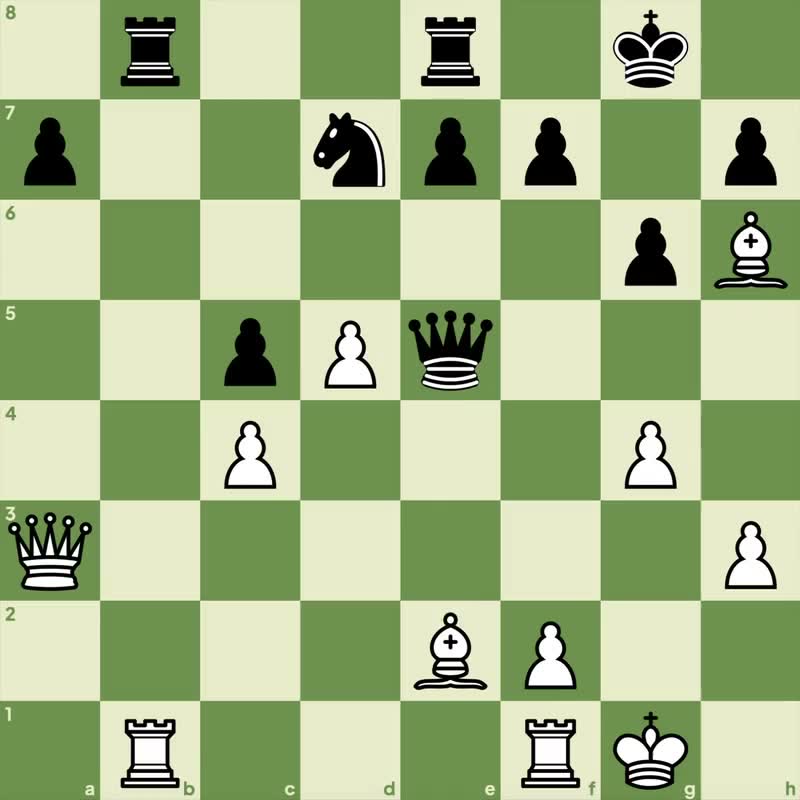
Best Chess Calculation Training Tools
Seven things to look for, and how apps, puzzle sites and books compare.
Best Chess Apps 2026
Nine chess apps for playing, kids, lessons, courses, tactics, game analysis and calculation, what each is best for and what is free.
Best Chess Calculation Training Apps 2026
Nine apps that train chess calculation, what each costs, and where each one beats ours.
Free Chess Calculation Trainer
Six free ways to train chess calculation, what each one gives you free, and where the free part stops.
Best Chess Visualization Apps
Analysis boards and visualization trainers are not the same thing. Seven apps, what each one does for your calculation, and what it costs.
Best Blindfold Chess Training Apps
Seven apps for training blindfold chess, from naming a square to a game on a blank board, and what each does for your calculation.
Best Chess Apps to Stop Blundering
Five apps that catch your blunders, what each costs, and which ones make you calculate the reply first.
Best Chess Training Apps 2026
Six chess training apps for calculation, lessons, courses, tactics and game analysis, what each costs, and what each does best.
ChessVis Alternatives
Four apps to use instead of ChessVis, or beside it, for visualization and calculation, and what each one costs.
Chess Calculation Training App Without Moving Pieces
Four apps, whether the board moves while you work out the line, and how you enter your answer in each.
Chess App That Makes You Calculate the Whole Line
Most puzzle apps check one move, then play the reply on the board. Two apps make you calculate the whole line.
Lichess vs Chess.com, which is better in 2026?
Price, free limits, puzzles, lessons, analysis, bots, apps and the rating difference, side by side.
Calculationtraining.com Alternatives for Chess Calculation
Five apps and a book to use beside Calculation Training's one position a day, what each one checks and what it costs.
Lichess to Chess.com rating, conversion tables for blitz, rapid and bullet
Find your Lichess rating and read off the Chess.com rating that matches it, for blitz, rapid and bullet, with FIDE as well.
Best app to learn chess, and what to use at each stage
Seven apps that teach chess, how each one teaches, what is free, and which to use from your first lesson to your first rating.
Best free chess app in 2026, what you really get for free
What six chess apps give you free, puzzles a day, analysis, bots, ads and offline play, and what each paid plan adds.
Best chess puzzle trainer, eight tools compared by how they train
Spaced repetition, themes, custom sets, repeat cycles and progress tracking, tool by tool.
Best chess puzzle websites, six sites to solve in your browser
Six sites where you can solve chess puzzles in the browser, what's free, and whether you need an account.
Best chess visualization websites, seven to open in a browser tab
Seven sites where you can practice seeing the board in your head straight from a browser tab, and what stands between you and the first exercise.
Best chess visualization tools, a toolbox sorted by the job
An analysis board, a blindfold setting, coordinates, pieceless positions and a real board. What each tool is for, and when to reach for it.
Best chess visualization platforms, six places to train and keep score
Six places you could make your home for visualization training, what each covers and tracks, and what you'd still need from somewhere else.
Best chess visualization trainer, one session to day 30
Six visualization exercises you can repeat every day, what one session looks like, how each gets harder, and where you stand after a month.
Best chess calculation websites, six to open in a browser tab
Six sites where you can practice calculation in a browser tab, how far you get without an account, and which ones make you see the whole line.
Best chess calculation platforms, where to train and keep track
Six places to make your home for calculation training, what each keeps track of, and what you'd still need from somewhere else.
Best chess calculation trainer, eight compared session by session
What one session looks like on eight sites, how each gets harder, what a wrong line costs, and what you have by day 30.
Best chess tactics websites to learn tactics by theme
Six websites where you learn tactics motif by motif, what each explains when you miss, and which make you calculate the line.
Best chess tactics tools, a toolbox sorted by the job each one does
Seven tactics tools, from an analysis board to spaced repetition, and when in your training to reach for each.
Best chess tactics platforms to make your training home
Five platforms where your tactics training can live, what each tracks over months, and what you'd still need from somewhere else.
Best chess tactics trainer, seven compared one session at a time
What one session is like on seven tactics trainers, what a miss costs, and what you have after a month.
Best chess websites, sorted by what you want to do
Six chess websites sorted by the job, play, learn, solve, study master games, follow top events or analyze, all in a browser tab.
Best chess tools, sorted by the job each one does
Eight chess tools sorted by the job each one does, from analysis and openings to tactics and endgames, and when you'd reach for each.
Best chess platforms, five places to make your chess home
Five chess platforms judged as a whole, what each covers and tracks, what's free for good, and what you'd still need from somewhere else.
Full calculation mode takes one position through four steps (tactic, candidate moves, calculation, evaluation). You can calculate just the main line or the whole calculation tree, and every line is checked at the end.