Chess quiz, 12 positions to test your calculation

Most chess quizzes you'll find online are trivia. Who was the first world champion, how many squares are on the board, what is castling. That's fine, but knowing facts about chess is not what wins games. So this quiz is mostly positions. There are twelve of them, and each one asks a single concrete question, the kind you have to answer in the middle of a real game. Is that piece really free? Should I take back straight away? Who queens first? How many moves until mate?
You can't answer any of them by glancing at the board. You have to calculate, which means seeing the moves and your opponent's replies in your head before you play. At the end there's a short knowledge round for anyone who came for trivia, and a score guide that tells you what to work on next.
How to take this chess quiz and score your calculation
Every position is White to play, and they get harder as you go, in three rounds of four. Read the question, then work out the whole line in your head, including your opponent's best reply, before you touch a piece. When you're sure, play it on the board, and Black's replies are played for you. When the line is done, the answer opens.
Give yourself one point for each position you solved on the first try. If you needed a second attempt, or you found the right move without knowing why it works, don't count it. In a game you only get one try, so that's the fair way to score it.
Round one, four warm-up questions to start calculating
The answers here are short, one or two moves, but each question still asks you to check what your opponent can do back. Question 4 has a trap in it, because the natural move is not the best one.
White to play. Find the winning move.
Show answer
Qh8#. The bishop on d4 guards the queen, so the king can't take her.
White to play. Find the winning move.
Show answer
Mate in two. 1.Qxh7+ Kxh7 2.Rh5#. The queen sacrifice opens the h-file, and the bishop on b3 covers g8.
White to play. Find the winning move.
Show answer
No. 1.Qa4+ Kf8 2.Qxe4. Black has to answer the check, and nothing guards the bishop.
White to play. Find the winning move.
Show answer
Not yet. 1.Qxh8+ Ka7 2.Rxd1. Take the other rook with check first, and you come out a rook up.
Round two, four questions where you calculate the replies
Now the lines get longer. In each of these the first move is only half of the answer. The real question is what happens two or three moves later, after your opponent has made their best reply.
White to play. Find the winning move.
Show answer
White does, if it starts at once. 1.a6 h4 2.a7 g3 3.hxg3 hxg3 4.a8=Q. Take on g3 first, and Black's pawns are still too slow.
White to play. Find the winning move.
Show answer
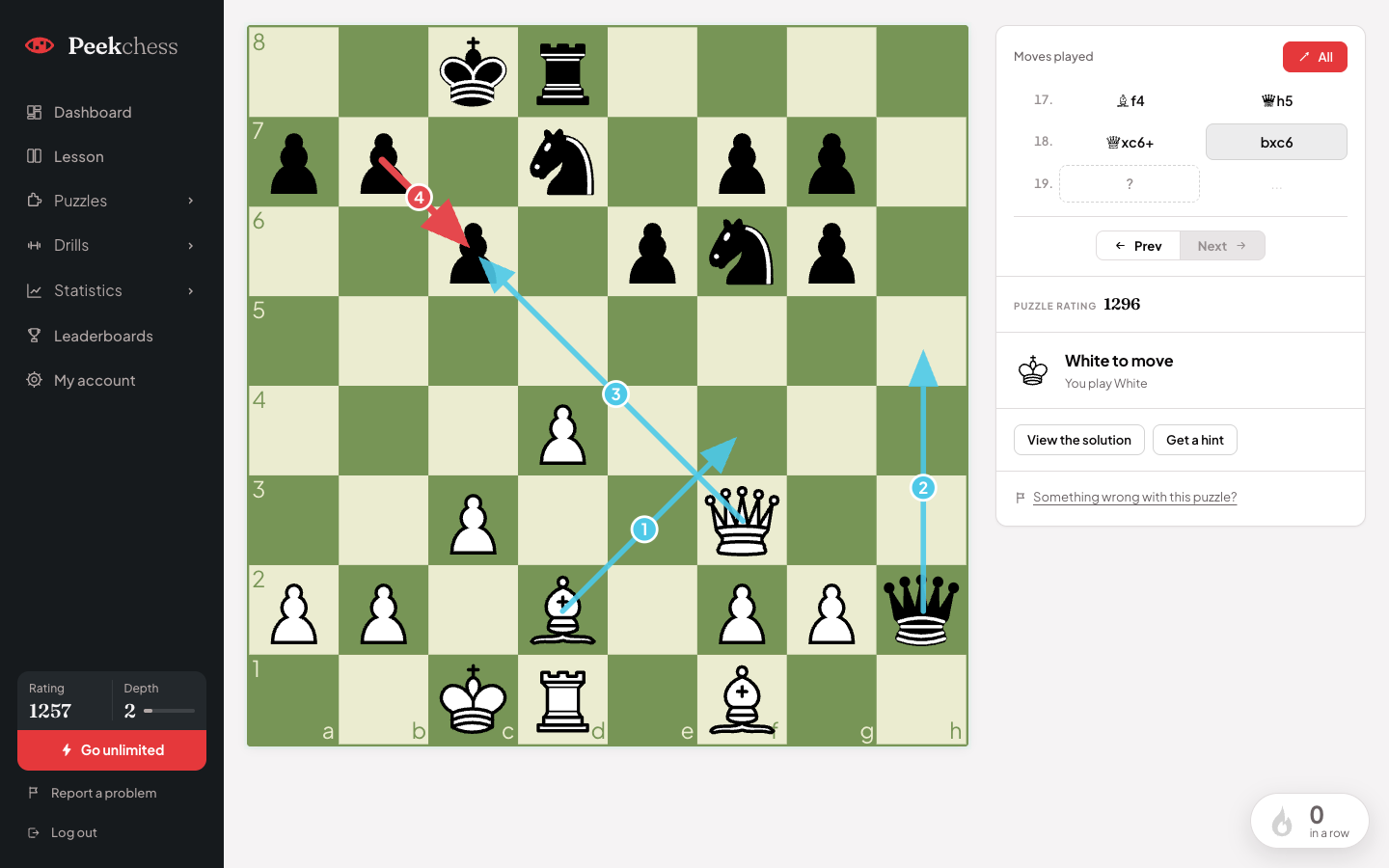
Yes. 1.Bg5 Qh5 2.f4 Qg6 3.Bh5 h6 4.Bxg6. Each move attacks the queen again, until she has no square left.
White to play. Find the winning move.
Show answer
Mate in three. 1.Rxg7+ Rxg7 2.Qxh6+ Kg8 3.Qh8#. The rook sacrifice removes the pawn that guarded h6.
White to play. Find the winning move.
Show answer
Yes. 1.Nf6+ Rxf6 2.Qxe8+. The rook has to take the knight, and then nothing guards e8.
Round three, four hard questions that need deeper calculation
Take your time with these. In two of them the first move isn't even a check, so before you play it you have to be sure your opponent has nothing better in reply. Three are endings, where a single move often decides the game, so count the moves.
White to play. Find the winning move.
Show answer
Yes, if every move is a check. 1.h4+ Kf5 2.Rc5+ Bd5 3.Rxd5#. Black never gets time for ...d1=Q.
White to play. Find the winning move.
Show answer
No. 1.Rc6 Rb7 2.Rxh6+. Rc6 cuts the rook off from h6, and taking on c6 lets the pawn run.
White to play. Find the winning move.
Show answer
Yes. 1.a5 Ke5 2.b6 axb6 3.a6. The a-pawn runs through, and the black king is too far away.
White to play. Find the winning move.
Show answer
To g7. 1.Qxg7+ Kxg7 2.Nf5+ Kg8 3.Nh6#. Nf5+ is a double check with the bishop on c3.
A short chess knowledge round, with the numbers behind calculation
Most people searching for a chess quiz want trivia, so here's a short round of it. I've kept mostly to questions with a calculation side to them, because the numbers explain why nobody can simply look at every move. Answer all seven, then check below.
- How many different first moves does White have at the start of a game?
- After one move each, how many different positions can be on the board?
- After two moves each, in how many different ways can the game have gone?
- Your king is in check. Can you get out of it by castling?
- Your opponent's pawn has just moved two squares and landed beside yours. If you don't take it en passant straight away, can you still do it a move later?
- The side to move has no legal move and isn't in check. What is the result?
- Who was the first official world chess champion?
The answers, in the same order.
- 20. Each of the eight pawns can move one or two squares, which makes 16, and each knight has two squares.
- 400. Twenty first moves for White, times twenty replies for Black, and every one of those positions is different.
- 197,281. That's after only two moves each. It's why nobody calculates everything, and why strong players look at checks, captures and threats first.
- No. You can't castle out of check, through a square that is attacked, or into check.
- No. En passant is only possible on the very next move. Play anything else and the chance is gone.
- Stalemate, and the game is a draw.
- Wilhelm Steinitz, who beat Johannes Zukertort in 1886 in the match most historians count as the first official world championship.
Questions 4 to 6 matter most over the board. A line you calculate is only right if you apply the rules correctly in your head, and castling, en passant and stalemate are exactly the rules that can turn a winning line into a draw or an illegal move.
Your score, and what to train next for your calculation
Count your points from the twelve positions. Here's how I'd read the result.
| Score | What it tells you | Train next |
|---|---|---|
| 0 to 4 | You see your move, not the reply | Chess puzzles for beginners, then mate in one |
| 5 to 8 | Short lines hold, longer ones slip | Mate in 2 and the calculation guide |
| 9 to 11 | You calculate well most of the time | Hard chess puzzles |
| 12 | Nothing slipped | Hard chess puzzles, all in your head |
If you scored four or fewer, don't worry about learning more patterns yet. Go back to short puzzles and change one habit, which is to find your opponent's best reply before you play anything. The chess puzzles for beginners and the mate in one puzzles are a good place to build it, because the lines are short enough to see completely.
In the middle band the problem is usually that the first move is right and the rest of the line wasn't calculated. Questions 4 and 5 show it well. In question 4 the natural recapture misses a free rook, and in question 5 the obvious race lets Black queen as well if you push the pawn at the wrong moment. Mate in two and three are good practice here, because they force you to see the reply before the second move.
If you got nine or more, try the hard chess puzzles, and solve them the way you solved these, with the whole line worked out before you make the first move.
Why this chess quiz tests calculation and not facts
Most games aren't decided by who knows more about chess. They're decided by who sees a tactic in time. In our study of 50,000 decisive games, 61 of every 100 losses came from a tactic, and only 2 from the opening. A tactic is a short forcing line, and the only way to see it coming is to calculate it.
That's why I wrote the quiz this way. Every question is something you'd have to work out at the board, with the clock running and nobody to tell you whether you're right. You can learn everything in the knowledge round in five minutes. Calculation takes longer, and it only improves if you practise it the way you use it, in your head, before you move.
This is also the idea behind Peekchess, a chess puzzle app that trains calculation. It grew out of work I'd been doing by hand with my students for years. The board stays still while you solve, so you calculate the whole line in your head first and then play it, the same way you took this quiz.
If you're still choosing where to solve puzzles, here are the best chess puzzle apps in 2026.
Read next. Chess tactics puzzles for calculation, Hard chess puzzles to test your calculation and Mate in one.
What is a chess quiz?
A set of questions that test what you know about chess or how well you play it. Some are trivia about the rules and the history of the game. Others, like this one, give you positions and ask you to find the right move, which tests your calculation.
Is this chess quiz good for beginners?
The first round and the knowledge round are. If round one felt hard, try chess puzzles for beginners and mate in one first, then come back for rounds two and three.
How many moves are possible in chess?
At the start White has 20 possible moves, and after one move each there are 400 possible positions. After two moves each, the game can already have gone 197,281 different ways.
How do I get better at chess quizzes and puzzles?
Calculate before you move. Look at checks, captures and threats first, find your opponent's best reply to each, and only play when you have seen the whole line. Solving with the board still, without moving pieces to try things, makes this a habit.