Can adults still improve their chess calculation?
Yes. Chess calculation is a set of habits, and you can practice them at any age. You check your opponent's best reply, you follow the forcing moves, and you hold the position in your head while you do it. As an adult, what changes is mostly your time and the habits you already have, and you can work with both.
I won't promise you a rating here. What I can do is go through what really changes, what to train first and how long it takes before you notice it in your games.
Is it too late to improve your chess calculation as an adult?
The busiest question thread I found on Reddit's chess forums came from a 20-year-old who wanted to learn to play blindfold before his life ends. The top replies were jokes, but underneath them the answers were fairly consistent. Players who had learned it said it took months of regular practice, not a lifetime, and several could play blindfold at a rating somewhere between 1000 and 1600.
Other threads ask the same thing from further along. Adults in their late twenties and thirties, with jobs and children, wonder whether the work is still worth it, and the replies talk about time and patience far more than age. One player wrote that they went from about 1980 to 2150 FIDE at 31, mostly by working on tactics and calculation, which had been their weakest areas.
What changes for adults? Time and habits, not calculation itself
Calculation doesn't get harder with age as far as I can tell from these threads. Your situation does, in four ways.
- Less time. Work and family come first, as they should, so most adults train in short gaps.
- Tired evenings. Calculating is hard work, and after a full day a long session tends to turn into guessing.
- Old habits. If you have played for years, you have years of moving on instinct. Playing fast and hoping is a habit like any other, and it takes practice to replace.
- Patience. You can follow a plan, review a loss honestly and keep a routine going for months, which counts for a lot in calculation training.
Habits matter more than speed. In our count of 50,000 games, 61 of every 100 losses came from a tactic. In 95 of 100 of those tactic losses, the loser still had at least a minute on the clock, and the losing move typically took 11 seconds. So most of the time the clock wasn't the problem.
If you are short on time, that's good news. The most useful change happens at the board, in a few seconds before each move, and not in hours of study.
I see the same thing in lessons. Before Peekchess existed, I was already doing this by hand with my students. I drew the moves as arrows on a shared screen and left the pieces where they were. With lower-rated players I kept it to a few moves at a time, and stronger players calculated much deeper. The most common mistake is the same at every level. A player spots one move, decides it's great and plays it without calculating. And when they do calculate, they don't picture the opponent's best replies, as if they could play several moves in a row. The big puzzle platforms encourage solving one move at a time, and that turns into a bad habit in games.
Do adults need blindfold chess to improve their calculation?
No, although it can be fun to learn. In that same thread a player rated 2400 said their own blindfold play was poor and that training it wasn't worth the effort, while others said it had helped their calculation. Both can be true. Blindfold chess asks you to hold the whole board from memory, and a real game never asks that of you.
In a game the board is in front of you. What you carry in your head are the changes, such as the piece that moved, the one that was taken and the square that is now open. That's the skill to train, and blindfold chess training goes into the difference.
What should adults train first for better calculation?
I would work through these in order, and only move on when the previous step feels easy.
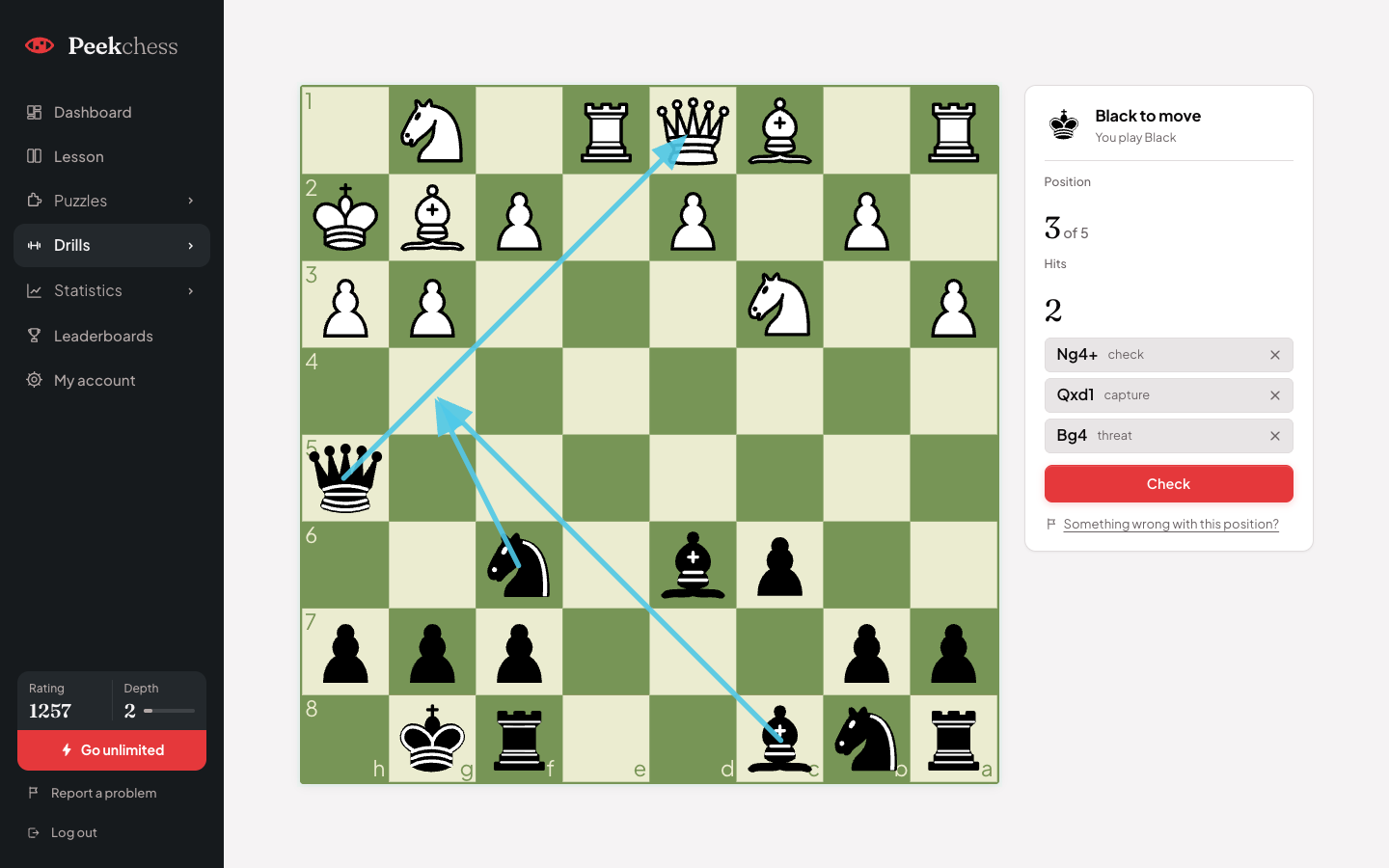
- A check before every move. Before you play, look at your opponent's checks, captures and threats after your move. That's one move for each side, 2 plies, and it catches the losses that are punished right away.
- Puzzles solved in your head. Calculate the whole line, including the defender's best reply, before you touch a piece. Short lines first.
- One move deeper. When a depth feels easy, add one move (2 plies). Not three.
- Keeping track of the board. Read a short line without moving the pieces, then check where everything ended up. This is what blindfold training aims at, without the blindfold.
- Reviewing your losses. Find the move where the game turned, and ask what you would have needed to see.
If you are starting from the very beginning, how to see more than one move ahead has a short routine you can use in every game.
How much time a day does calculation training take?
Less than most adults expect. Fifteen minutes when you are fresh beats an hour after a long day, and ten puzzles you calculate fully teach more than fifty you guess. Doing it most days matters more than doing a lot at once.
When you have a free evening, play a longer game and use the time on your clock to calculate. If you want a plan to start with, the 7-day visualization and calculation routine lays out fifteen minutes a day for a week.
How long before better calculation shows in your games?
Nobody can give you a number, because it depends on where you start and how often you train. But the changes tend to arrive in this order.
- The first weeks. The check before every move can become automatic, as long as you use it in every game, casual ones included.
- The first months. Lines of 2 moves (4 plies) start to feel normal. That fits what adults in the blindfold thread reported, months of steady practice for a skill that felt impossible at first.
- After that. Longer lines take much longer. Adults who posted their own progress described a fast start and a slower climb later.
Slower doesn't mean stuck. The higher your rating, the further ahead you need to see. In our study, under 1200, 43 of 100 tactic losses needed 2 moves or more (4 plies), and at 2100 and up, 74 did. Each step up asks for more calculation, so it's reasonable to expect each step to take longer. The full study has every rating band.
Where does Peekchess fit in an adult's calculation training?
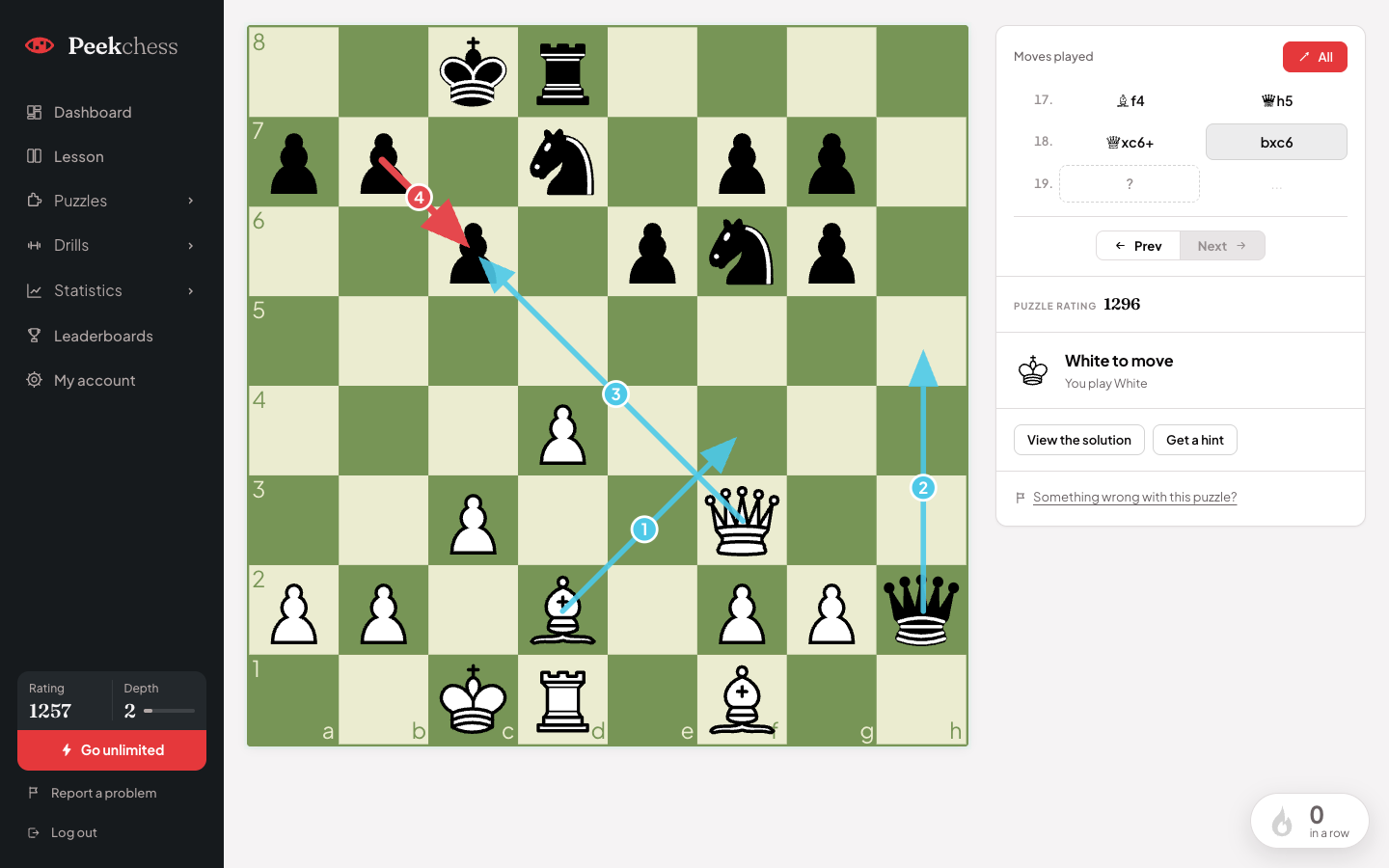
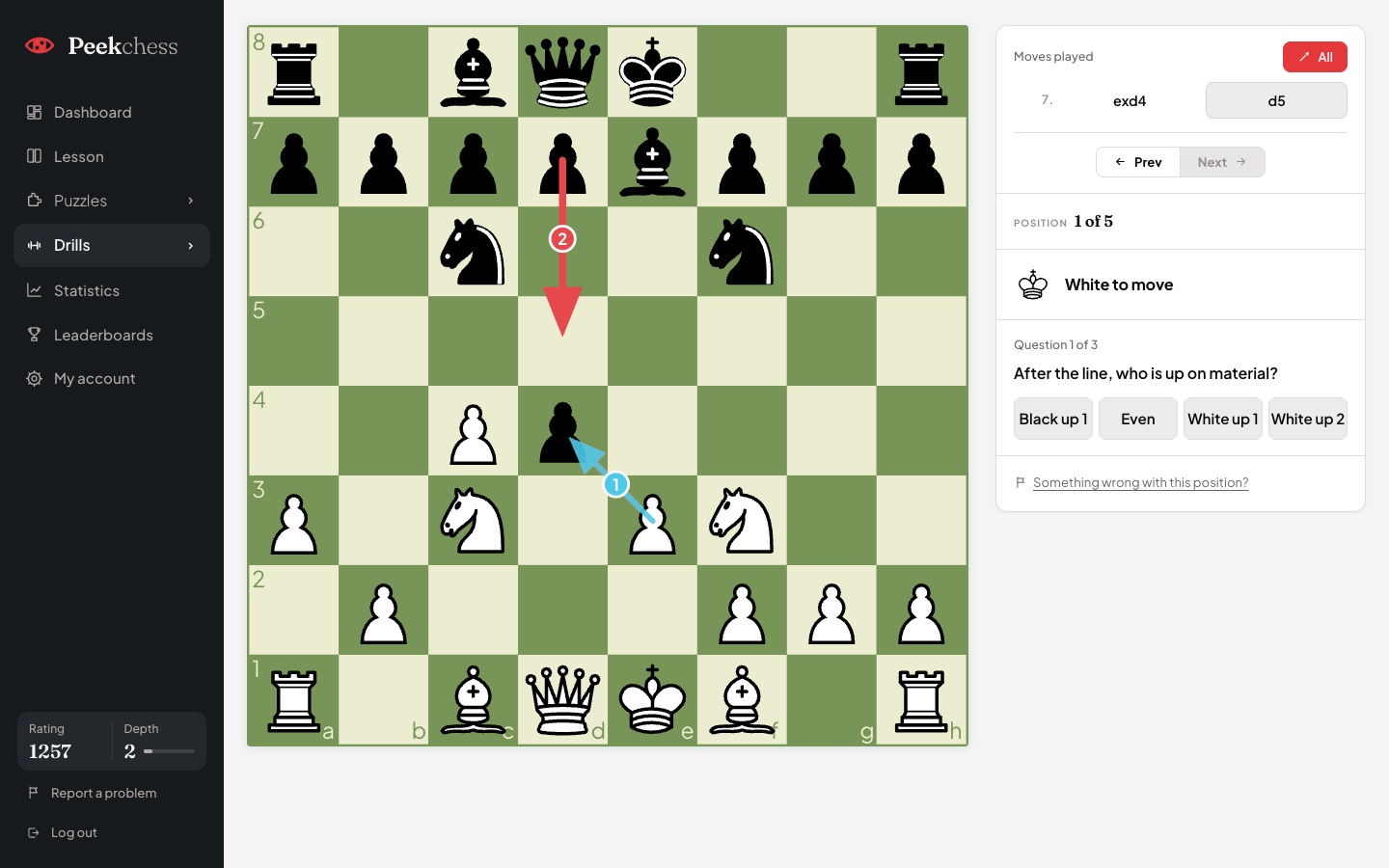
Peekchess is a chess puzzle app that trains calculation, and it works the way I used to teach by hand. Here is what happens in a puzzle.
- The board stays still, and the puzzle's first moves land as arrows.
- You play every move of the winning line yourself.
- Each move is checked as you play it, and each move is drawn as an arrow.
- One wrong move ends the puzzle.
Because the pieces never move, you have to keep the new position in your head, which is what a game asks of you. A lesson is ten puzzles, which fits a short gap in the day.
You can do all of this without it, too. A book, a board and one rule will do, which is that you don't touch a piece until the line is finished.
If you're still choosing where to solve puzzles, here are the best chess puzzle apps in 2026.
Read next. Chess calculation for beginners, A 7-day routine to improve chess visualization and calculation and Chess rating plateau? Why your puzzles skip the calculation.
Can you get better at chess calculation as an adult?
Yes. Calculation is a set of habits, such as checking your opponent's best reply and following forcing moves to the end, and you can practice them at any age. What adults usually lack is time, so short daily sessions work best.
Am I too old to get better at chess?
Players on chess forums who learned to play blindfold as adults spoke of a few months of regular practice, and that's a harder skill than a normal game asks for. Calculation improves with practice in the same way. Nobody can promise a rating, but it isn't too late to train.
How long does it take to improve chess visualization?
It depends on how often you train. Adults who described it on Reddit mostly spoke of months of steady practice. Short sessions that go one move deeper at a time work better than rare long ones.
Do I need to learn blindfold chess to calculate better?
No. In a game the board is in front of you, and you only hold the changes in your head, so that's what to train. Blindfold chess is a separate skill that some players enjoy.
How much chess calculation training should an adult do a day?
About fifteen minutes, or ten puzzles you calculate fully before you move. Doing it most days matters more than doing a lot at once.