Why you lose track of the pieces in a long calculation

You calculate a line a few moves deep, you like the position at the end, and you play the first move. Then the whole thing falls apart. Somewhere in the line you traded off a piece that was still part of your plan, or a rook you had already moved was still guarding its old square in your head. Players call this hallucinating pieces. It's one of the most common ways a perfectly good calculation goes wrong, and it's something you can train.
What does losing track of pieces look like in a calculation?
It usually shows up in one of four ways, and most players have one they fall for again and again.
- The captured piece that's still there. You trade knights early in the line, and a few moves later your plan still relies on your knight, or forgets that theirs has gone.
- The piece that moved but still guards. Early in the line your rook leaves a1 for a7. A few moves later it's still on a1 in your head, covering the back rank.
- The square that was emptied. A piece leaves a square, and that opens a diagonal, a file or an escape square. The board in front of you still shows that square as occupied, so you never look through it.
- The quiet defender at the end. You finish the line with a check, go through every king move, and miss that a pawn can simply block the check. The defender was there all along, it just wasn't part of the action.
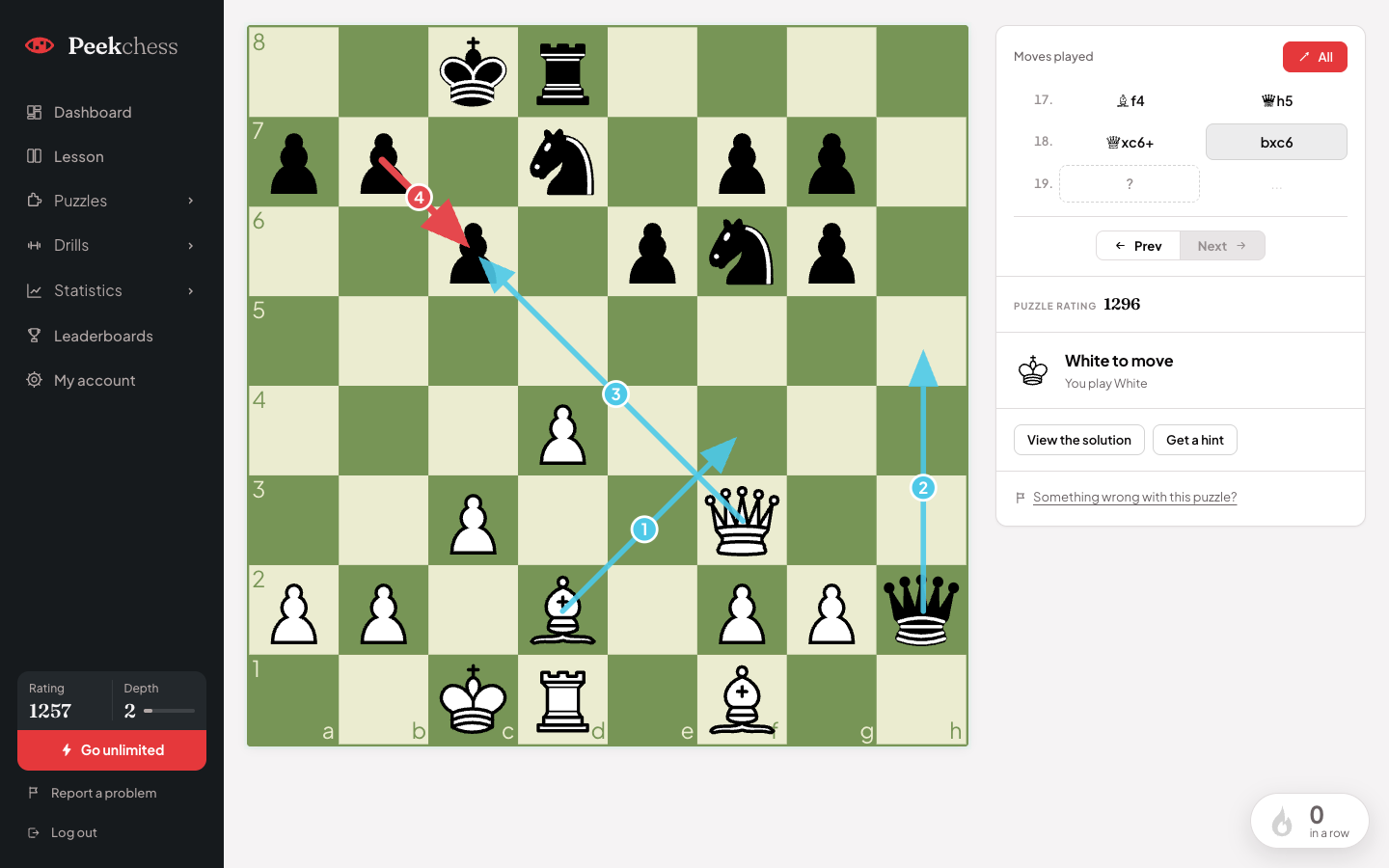
The diagram is the second kind. White's rook was the piece guarding the back rank, and once it goes to c7, nothing covers e1 any more. If you still see the rook on c1 in your head, you won't even look at e1.
Why does your calculation lose the picture?
Mostly because the board in front of you never changes. When you calculate, you're looking at the real position and moving the pieces in your head on top of it. Every move in your line is a change you have to hold against a board that keeps showing you the old position. The rook you moved is still sitting on a1, right there in front of you, so your eyes keep putting it back.
Three things make this harder.
- Your attention follows the action. You naturally watch the pieces that are moving and attacking. A piece that left the line two moves ago, or got captured, drops out of view, even though the squares it used to cover are now open.
- Lines leak into each other. When you go back to try a second line, you first have to undo the one you just looked at, and bits of it tend to stay behind, like a pawn that moved in one line but not in the other.
- Long lines have more changes. Every extra move is one more difference between the position in your head and the board you can see.
The last one matters more the better you get. In our count of 50,000 lost games, we measured how many moves it took for each losing move to be punished. Under 1200, 43 of 100 tactic losses needed 2 moves or more (4 plies), and at 2100 and up, 74 did. The study only tells us how deep the missed line was, not why the player missed it. Still, a deeper line means more pieces have moved by the time you reach the end, and more for you to keep track of.
Is losing track in a calculation a memory problem?
Mostly it isn't. Many players who can play blindfold say they don't see a complete picture of the board at all. They describe it more as knowing where everything is and what each piece hits, a bit like walking through a room you know well in the dark. Very few people hold all 64 squares at once. They look at the part of the board that matters, the same way their eyes do over a real board.
That's good news for you. You don't need a sharper picture of the board, you need to keep the list of changes straight, meaning what moved, what was taken and what each piece no longer guards. That's a habit, and habits can be trained. When club players asked about this, the answer they got again and again was that it's normal at their level and that it gets better with practice.
How do you stop losing track of pieces in your calculation?
Here are four habits you can start using in your next game.
- 1Say what changed after each move. Not only the move itself, but what it changed. "The knight on f6 is gone, so h7 has lost a defender." Putting it into words makes the change stick.
- 2Stop at the end and take stock. Before you judge the final position, go through it piece by piece. Where are both queens, and which pieces are loose? Then look for your opponent's checks, captures and threats, and for the simple blocking move.
- 3Start each new line from the real board. When you finish a line, look back at the actual position in front of you and start the next line from there, not from wherever the last one ended.
- 4Count the material at the end. If the line had two trades in it, count what's left for both sides. A piece that's still there in your head usually shows up as material that doesn't add up.
Which drills train keeping track in a calculation?
The habits help during a game, but the skill itself is built between games. Do one of these drills for a few minutes a day, and make the line one move longer whenever you get it right.
- Read a line without moving the pieces. Set up a position from an annotated game and read the next few moves from the notation. Then ask yourself questions about where you ended up, such as where the queens are and what can be taken. If you lose the position, play one move on the board and carry on from there.
- Only look at the board every few moves. Play through a game in your head and set up the position every 3 moves to check it. When that gets easy, try every 6. Some clubs do this with a partner who calls out the moves.
- Solve puzzles before you touch a piece. Work out every line and write it down first, then play it on the board and compare. When you miss, you can see exactly which piece you lost.
- Follow the side lines in a book. When a book gives a variation in brackets, follow it in your head instead of setting it up.
It also helps to note which piece you lost each time. Most players lose the same kind of piece again and again, often a knight after it jumps, or a bishop whose diagonal opened when a pawn moved. Once you know yours, train that piece. There are more drills in five chess visualization exercises, each with a version you can do without an app.
Can Peekchess train keeping track in a calculation?
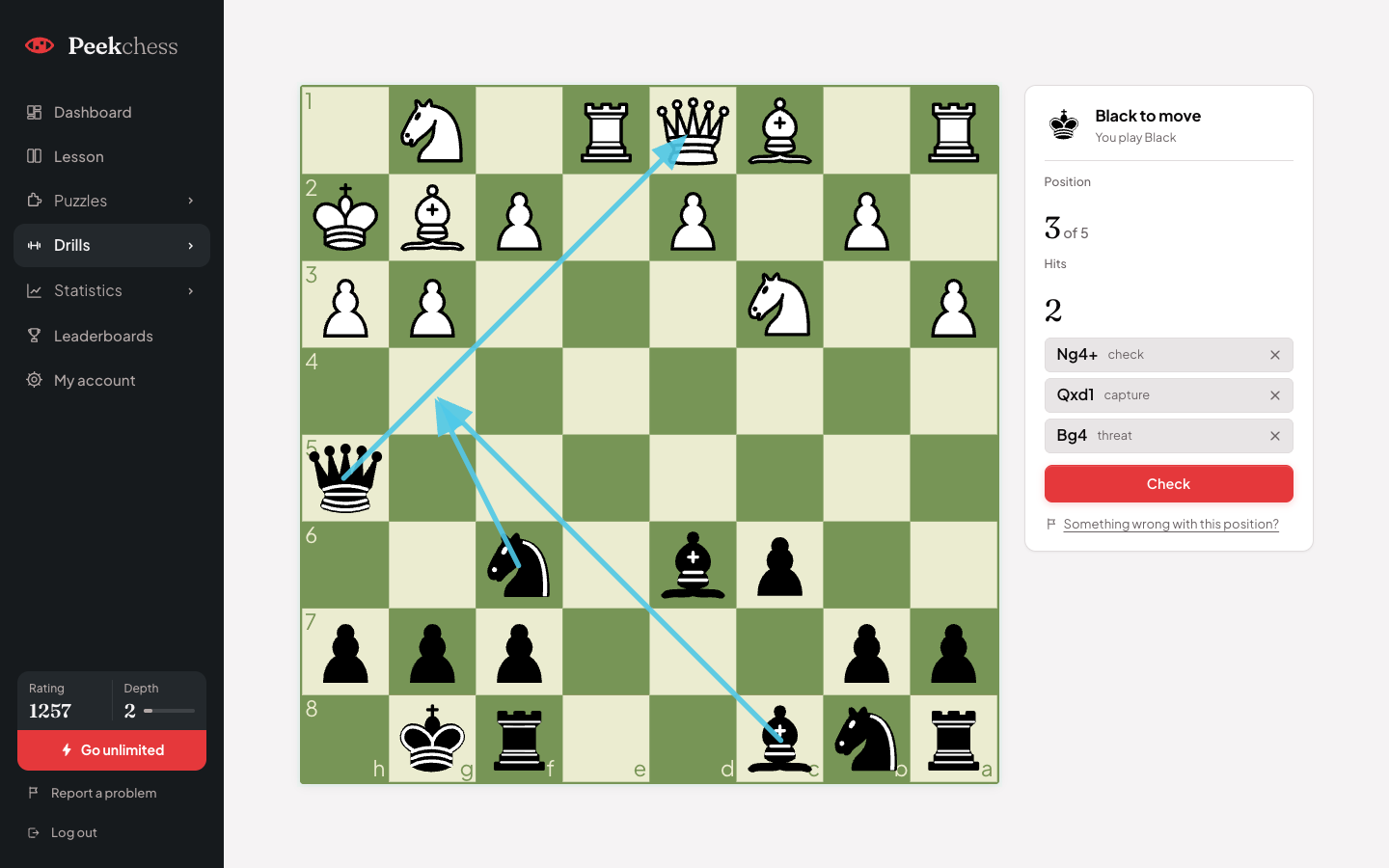
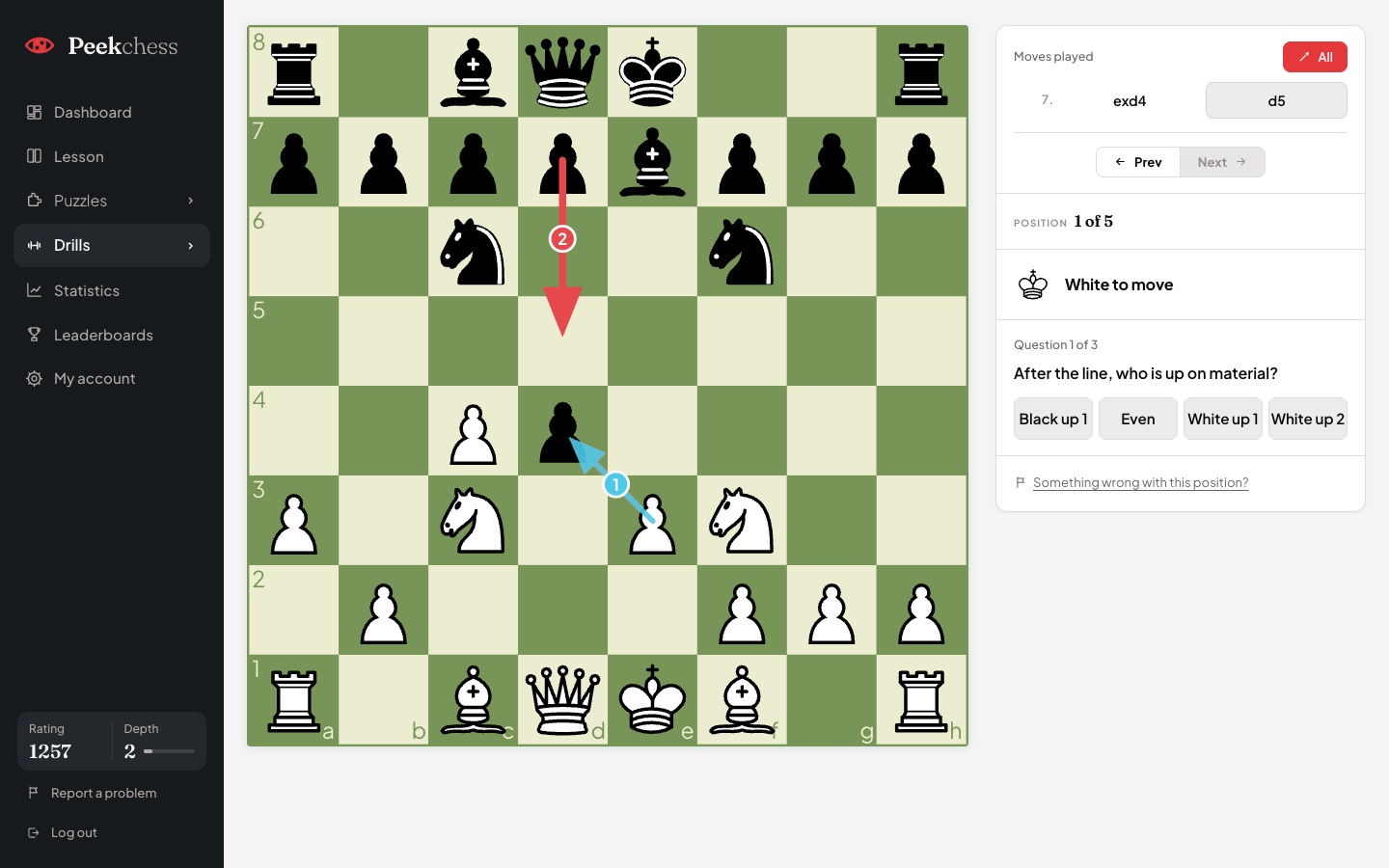
Yes, there's a mode built for exactly this. In Keeping track you read a stretch of a real game, stopped before the blunder, while the board stays still, so every change happens only in your head. Then you answer three questions about where the line leaves you, on checks, captures, attacks, pins and material. You set the depth yourself, which lets you make the line longer a little at a time. It's free, with no daily limit.
The puzzles work on the same idea. The pieces never move, each move is checked as you play it, each move is drawn as an arrow, and one wrong move ends the puzzle. So you have to hold every change in your head, just as you would in a game. Peekchess grew out of this kind of work, which I was doing by hand with my students for years.
If you're still choosing where to solve puzzles, here are the best chess puzzle apps in 2026.
Read next. What is visualization in chess, 5 chess visualization exercises that carry over to calculation in games and When to stop calculating in chess.
Why do I keep hallucinating pieces when I calculate?
Because the board in front of you still shows the starting position. Pieces that were captured or moved earlier in your line keep their old squares on the real board, and your eyes put them back there. Saying what changed after each move, and taking stock at the end of the line, fixes most of it.
How do I stop losing track of pieces in long lines?
Train it one move deeper at a time. Read lines from notation without moving the pieces, check the position every few moves, and solve puzzles completely before you touch a piece. When you lose a piece, note which one it was and train that.
Do I need to learn blindfold chess to stop losing track?
No. In a game the board is right in front of you, and you only have to hold the changes. Short drills where you hold a line over a board you can see train that more directly than full blindfold games.
Is it normal to lose track of the position after a few moves?
Yes. It's very common at club level, even for players well past the beginner stage, and it gets better with steady practice, a little and often, one move longer each time.