When to stop calculating in chess, and where to spend your time

You stop calculating a line when it runs out of forcing moves, which means neither side has a check, a capture or a threat left. At that point you judge the position and move on. Your time should go to the moves that could lose to one of those. If you spend it evenly on every move, you'll be worn out long before the game is decided.
And the clock is rarely the real problem. In our study of 50,000 games, the loser still had at least a minute left in 95 of 100 tactic losses. The time was there. It just went to the wrong moves.
When should you stop your calculation?
A line is over when the position goes quiet, with no checks, no captures and no threats for either side. Until then, the next move can change everything. So a line that stops in the middle of a capture sequence isn't finished, however long it already is.
This is also why the forcing moves come first. In our 50,000 games we looked at the first move of the line that punished each losing mistake, and in 96 of 100 it was a check, a capture or a threat. If you've looked at all of your opponent's forcing replies and none of them works, you've checked the kind of move that started almost every punishing line we found.
Once the line does go quiet, stop and judge it. Count the material, look at both kings and decide who is better. Then compare that with where your other candidate moves end up. How to calculate in chess sets out all four steps, from spotting the moment to judging where the line ends.
Too short or a missed reply? Where calculation goes wrong
A thread on r/chess asked players which happens to them more often, a line they didn't calculate far enough or a resource for the opponent they missed inside the line. Most of the answers said the second. One put it simply, that a short line you got right beats a long one with a hole in it. Another pointed out that in very forcing positions you can go deep safely, while in quiet ones the hard part is choosing which lines to look at.
So before you go any deeper, make sure you haven't skipped one of their forcing replies on the way. At every step of the line, before you call it finished, look once more at their checks, captures and threats in the position you're picturing, not the one on the board.
A reply in another thread, about visualization and time trouble, made the same point from a different angle. When you miss something in a line, it often isn't a visualization problem. It's that you didn't update what changed after each move. A piece that moved no longer guards the square it left, and a pawn that captured may have opened a line to your king.
Is the clock to blame? What 50,000 games say about calculation time
For every tactic loss in our 50,000-game study, we looked at the clock on the losing move. It was rarely a case of time running out.
- In 95 of 100 tactic losses, the loser had at least a minute left.
- Half were played with more than 7 minutes left on the clock.
- Only 3 of 100 were played with under 30 seconds left.
- The losing move typically took 11 seconds, and the loser's moves before it took 8.
- About a quarter of losing moves were played in under 5 seconds.
So the losing move was typically played only a little slower than the moves before it, and often with plenty of time left. The study can't tell us what the player was thinking, and it doesn't prove that more time would have saved those games. What it does show is that the time was there. The question is where it went.
Which moves deserve your calculation time?
You can't calculate every move in depth, and you don't need to. Spend the time on the moves that can lose to a check, a capture or a threat. These are the usual ones.
- Captures and trades. Count every recapture to the end before you start the sequence.
- Sacrifices. If you give up material, you need to have seen how you get it back.
- A piece leaving a job. A rook leaving the back rank, a knight that guarded a square near your king, a pawn that was shielding a piece.
- Their move changed something. A new check, capture or threat on the board means you stop and look, however quiet their move seemed.
- You think you're winning. The winning move is the one to check twice, because if it fails, the game usually goes with it.
In a thread on r/TournamentChess, a player in a classical game saw a piece sacrifice within seconds, with 80 minutes on the clock, and spent under 2 of them on it. It worked, but the replies were clear. Use your first feeling to pick which move to calculate first, then check it properly, and look at the other candidate moves too. A winning chance is exactly the moment to slow down.
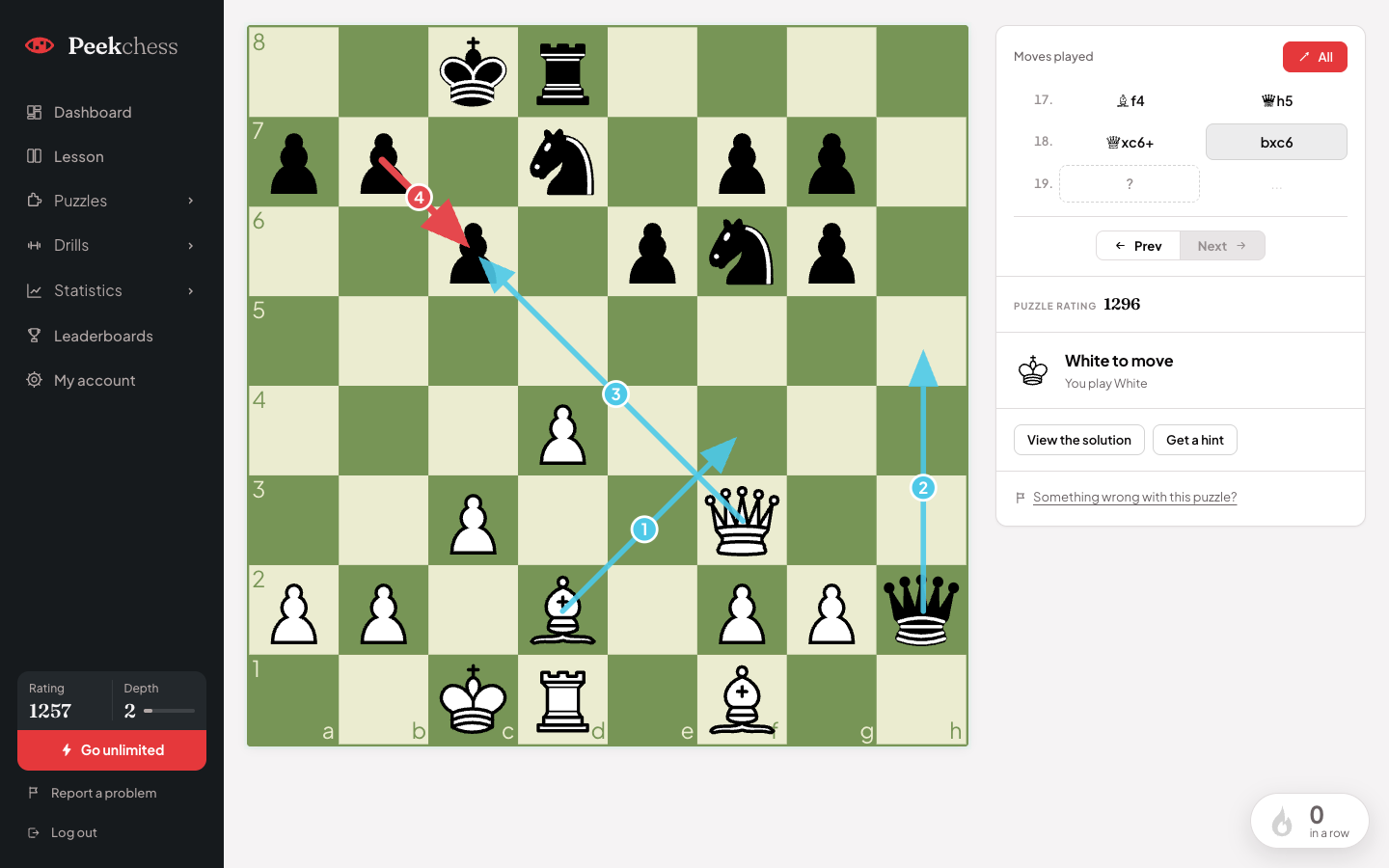
That's the whole idea in one position. The move looked harmless, but it took the rook away from a defensive job, and Black's reply was a check. A few seconds on Black's forcing replies would have caught it.
A blunder check in five calculation steps
- 1Picture the board after your move, not the board you see now.
- 2List their checks. Every one of them, even the ones that look silly.
- 3List their captures and threats. What can they take, and what would their best move attack?
- 4Find an answer to each one. If one of them has no answer, choose a different move.
- 5Then play it. Once every forcing reply has an answer, stop. Going over the same line again costs time and energy and doesn't find anything new.
On a quiet move with nothing forcing on the board, this takes a few seconds. On a capture or a sacrifice it takes longer, and it should. The three questions before every move go through checks, captures and threats one at a time.
How do you keep up your calculation without tiring out?
A player rated about 1500 on Lichess wrote that they couldn't keep their calculation going for a whole game. When they're tired after work or after a meal, they play everything fast and blunder, and their rating goes up and down with their energy. A club player at 10+2 described the other side of it. Under stress they skip the lines they don't think there's time for, and then they miss basic things.
- Don't calculate everything. Most moves only need the five-step check. Save deep calculation for positions where a check, a capture or a threat is in the air.
- Make the check a habit, not a decision. A routine you run on every move costs less effort than deciding each time whether to look.
- Keep lines short and accurate. Two moves (4 plies) you're sure of beat five moves (10 plies) with a hole in them.
- Know when to stop playing. If you're tired, play fewer games, or stop after a bad loss. Games played half asleep cost rating points and teach you very little.
- Train knowing when. Spotting whether a position has a tactic at all is a skill you can practice on its own.
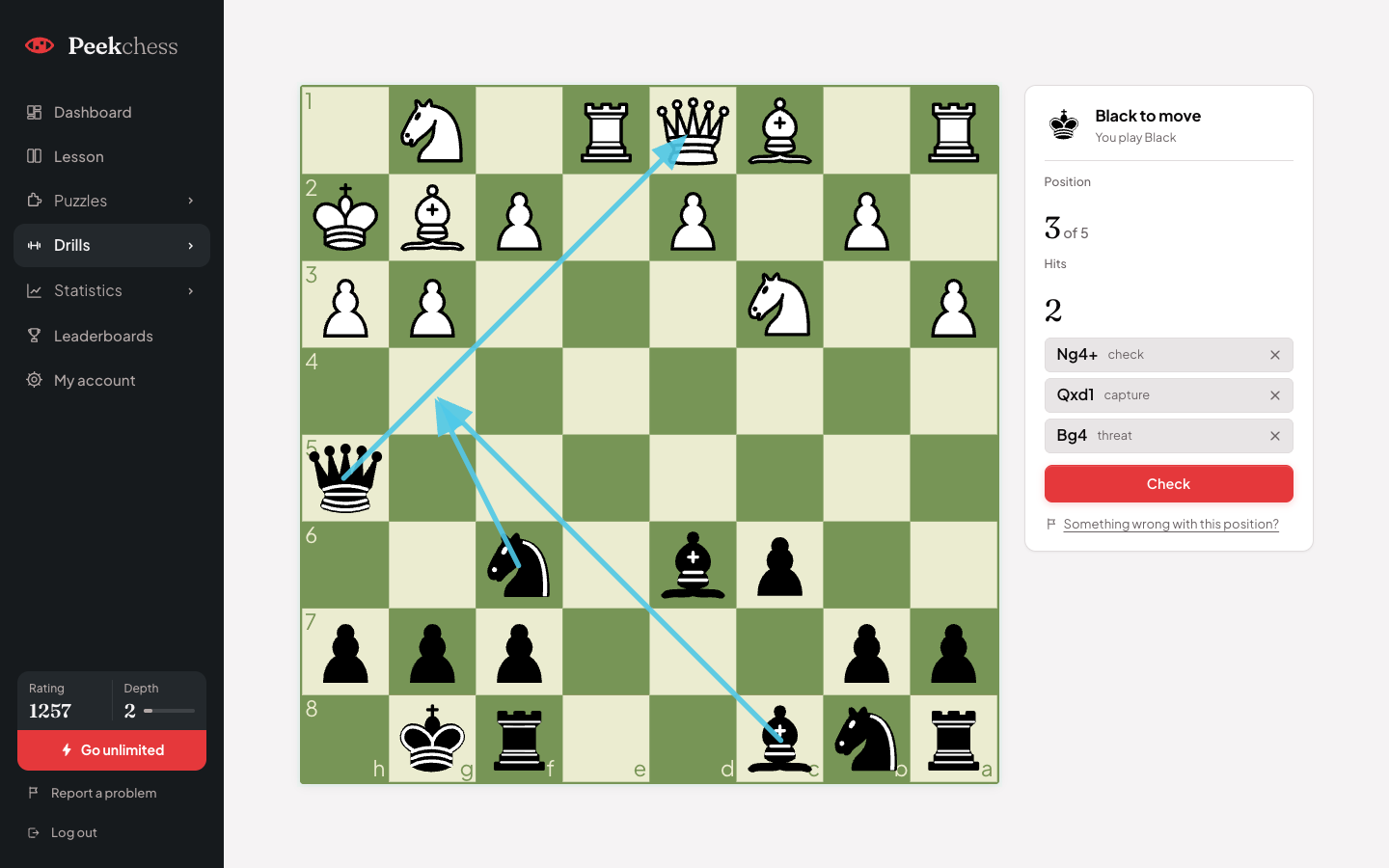
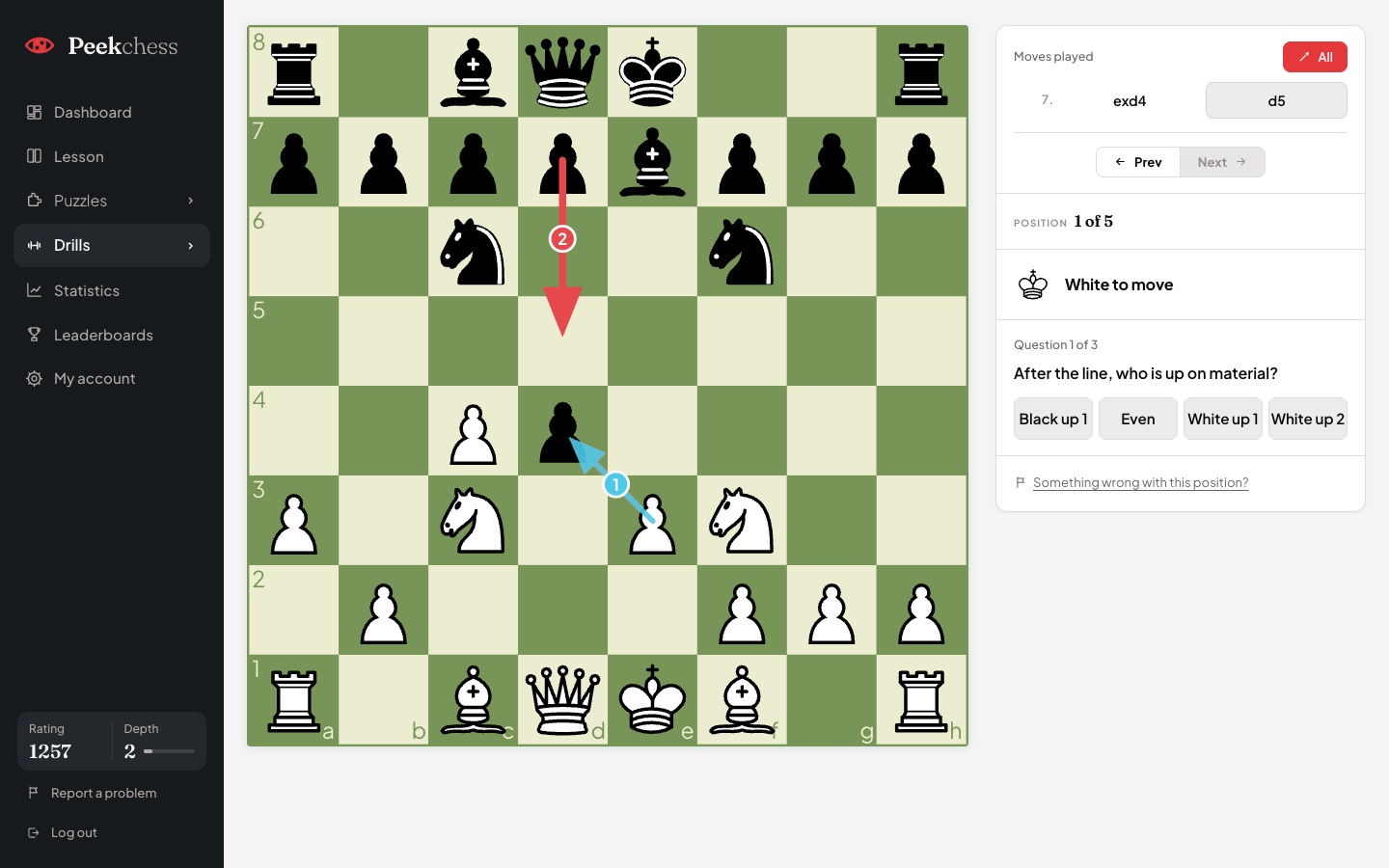
That last one is what the Critical positions drill in Peekchess is for. Each position asks you one question, whether there is a tactic in it, and sometimes there's nothing to find. It trains the moment to start calculating, so you save your effort for the positions that need it.
If you're still choosing where to solve puzzles, here are the best chess puzzle apps in 2026.
Read next. How many moves ahead do chess players think? Chess calculation by rating, Why you lose track of the pieces in a long calculation and Calculate the reply your opponent will actually play.
When should I stop calculating in chess?
When the line reaches a quiet position, with no checks, captures or threats for either side. Then judge who is better and compare it with where your other candidate moves end up. There's no fixed number of moves.
How long should I think on a move in chess?
It depends on the move. A quiet move with nothing forcing on the board needs a short blunder check. A capture, a sacrifice or a move that takes a piece off a defensive job needs a full calculation, even if that takes minutes in a slow game.
Why do I blunder when I have plenty of time?
Because the time goes to the wrong moves. In our study of 50,000 games, the loser had at least a minute left in 95 of 100 tactic losses, and the losing move typically took 11 seconds. Spend your time where a check, a capture or a threat can punish you.
How do I make myself double check a move that looks winning?
Treat a winning move as the one to slow down for. Use your first feeling to choose what to calculate first, then list every check, capture and threat your opponent has after it, and look at your other candidate moves before you play.
Why does calculating make me so tired?
Because calculating every move in depth is tiring. Run a short blunder check on quiet moves, and save deep calculation for positions with a check, a capture or a threat in them. A fixed routine also costs less effort than deciding each time.