Chess blindness, why you miss a move before you start calculating
Chess blindness is when you miss something that is right in front of you, like a piece you could simply take, a mate in one, or a threat a beginner would spot. It isn't a gap in your knowledge, and it isn't difficult calculation going wrong. You knew the pattern, and the move was only one step deep. You just never looked at that part of the board before you started calculating.

What is chess blindness, when the calculation was easy?

It's the blunder you can't explain afterwards. The calculation was easy, often a single capture or a single check, and in a puzzle you would have found it in seconds. In the game, though, your attention and your calculation were somewhere else.

It happens at every level. In November 2006 in Bonn, Vladimir Kramnik, the reigning world champion at the time, played a six-game match against the program Deep Fritz. In the second game he moved his queen to e3 and allowed mate in one. That position is the third one to solve further down.

Why does chess blindness happen before you calculate?

Mostly because you're calculating your own plan and nothing else. Chess players call it tunnel vision. You follow one line so closely that the rest of the board disappears, and because your attack is two moves away from mate, you stop asking what your opponent can do in one.

87654321abcdefgh
White sees Qh6, with mate on g7 coming next, and plays it straight away. Black doesn't wait, and Qxg2 is mate. Playing the pawn to f3 first would have closed the diagonal, and the game would have gone on.

Some moves also hide better than others, even from players who calculate well. Three kinds get missed again and again.

1Long movesA bishop, rook or queen crossing the whole board.
2Backward movesA piece going back towards its own side.
3Quiet squaresA piece left undefended after something else moved.

What did White miss before calculating?

None of these needs a long calculation. Each answer is one move deep, which is exactly the kind of move blindness hides.

What did White miss? In each position there is one move in plain sight. Pick a piece and then a square, or drag it to play your move on the board.
87654321abcdefgh
The long move

White to play. Find the winning move.

Show answer

Bxa8. The bishop goes all the way down the long diagonal and takes the rook. Nothing was in the way, and nothing defends the rook. Moves that cross the whole board are the easiest ones to miss.

87654321abcdefgh
The backward move

White to play. Find the winning move.

Show answer

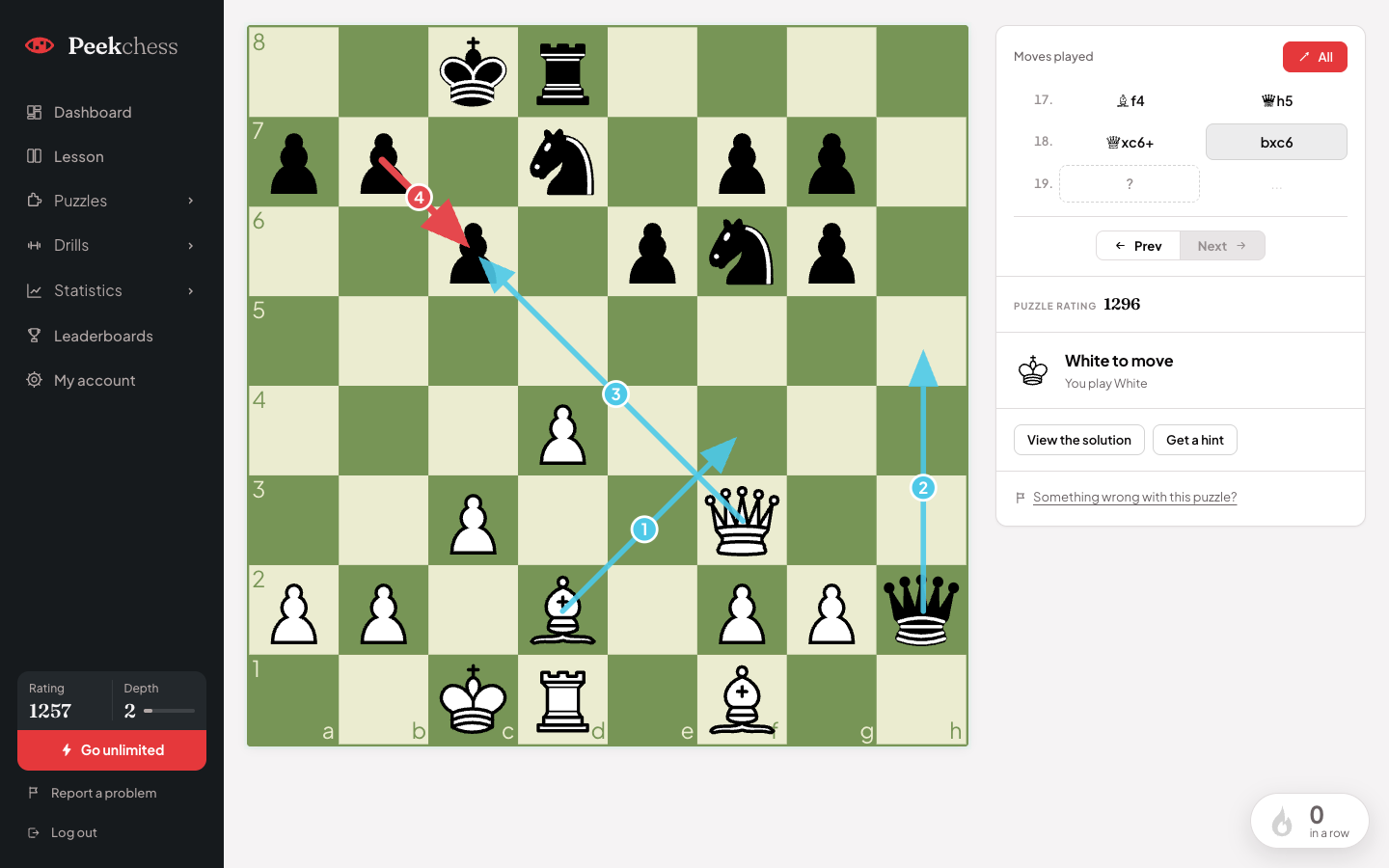
Qxd2. Black's rook has come down to White's second rank, and nothing defends it. The queen takes it by going backwards. We tend to look where our pieces are heading, not back where they came from.

87654321abcdefgh
The mate in one

White to play. Find the winning move.

Show answer

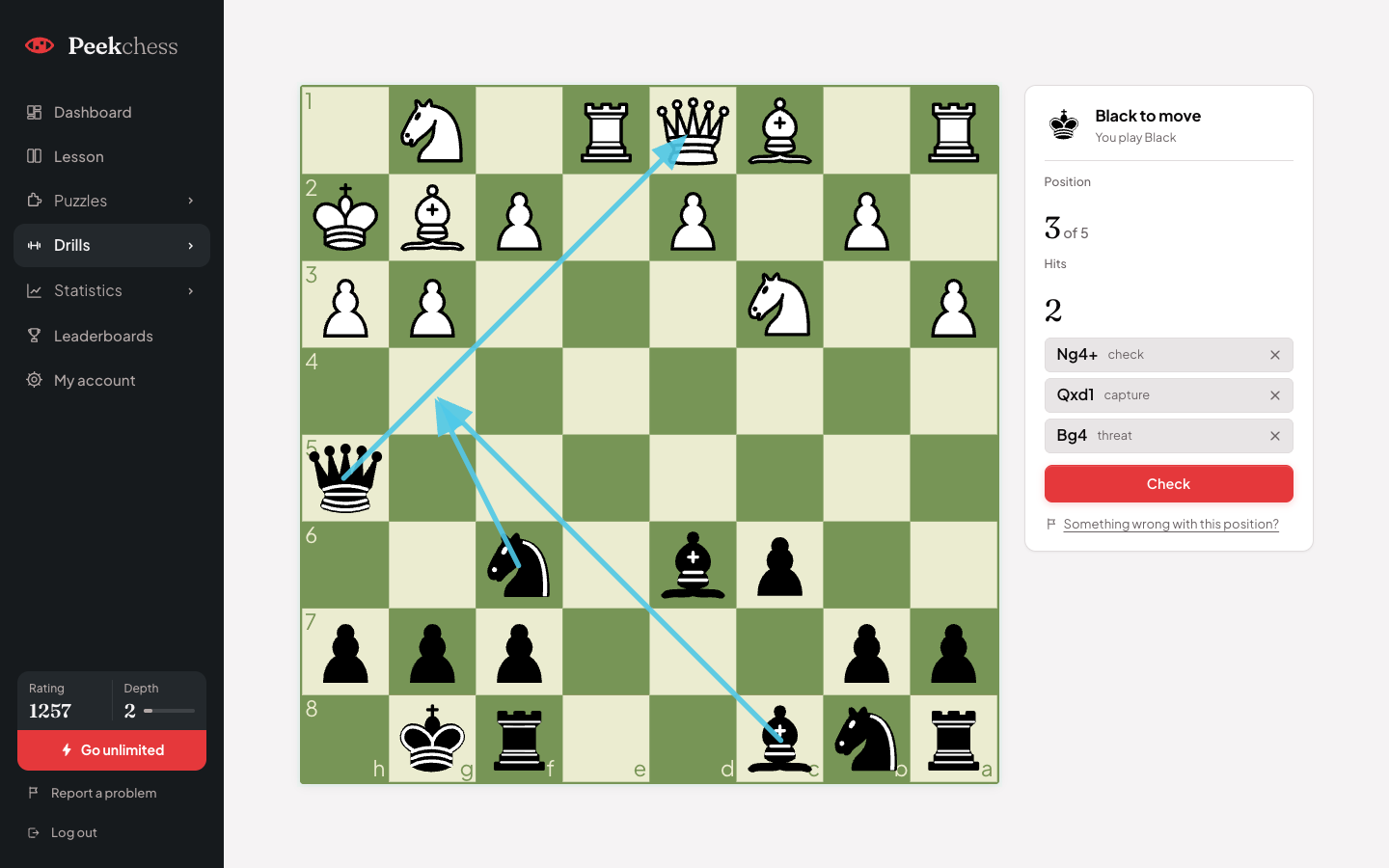
Qh7 is checkmate, because the knight on f8 protects the queen on h7. This is Deep Fritz against Vladimir Kramnik, Bonn 2006. The reigning world champion had just put his queen on e3 and didn't see it.

How do you stop chess blindness? One check before every move you calculate

Not by trying harder to concentrate, and not by calculating deeper. What stops it is a check you run before you calculate any move, done the same way every time, so that it doesn't depend on whatever you happen to be thinking about.

  1. 1Look at every check. Yours first, then theirs, even the ones that look silly.
  2. 2Look at every capture. Every piece that can take something, on both sides.
  3. 3Look at every threat. What does their last move attack, and what would your move leave undefended?
  4. 4Look at the whole board. Before you let go of the piece, run your eye along every long diagonal, file and rank.

It takes a few seconds a move, and it catches exactly the moves that blindness hides. Then you calculate, starting from whatever the check found. Three questions to stop blundering in chess turns this into a routine, and why do I keep blundering in chess? explains why your opponent's side of the board is the half you skip.

Is chess blindness the same as a blunder, or a calculation miss?

It's one cause of blunders, and a common one. A blunder is the bad move itself, and blindness is the reason you played it. You never saw the reply, so it never entered your calculation. A calculation miss is something different. There you saw the move and got the line wrong. Either way, these are the moments that decide games. In our study of 50,000 games, 61 of every 100 losses came from a tactic, and only 2 were decided by the opening.

The habit that cures it is the one puzzles should be building anyway. You see everything first, then you calculate, and only then do you move. Peekchess puzzles keep the board still while you solve, so you calculate the whole line in your head first and then play it.

If you're still choosing where to solve puzzles, here are the best chess puzzle apps in 2026.

Read next. How to stop blundering in chess with three questions before you calculate, Why do I keep blundering in chess? What your calculation leaves out and Mate in one.

What is chess blindness?

It's missing a move that is in plain sight, like a piece that can simply be taken or a mate in one. The player knows the pattern and the calculation would have been easy, but they never looked at that part of the board.

What causes chess blindness?

Mostly tunnel vision, where you calculate your own plan and stop looking at what your opponent can do. Long moves, backward moves and pieces left undefended are the ones that get missed most.

What is tunnel vision in chess?

It's calculating one idea, usually your own attack, so closely that you stop seeing the rest of the board. It's the most common cause of chess blindness.

How do you stop chess blindness?

Run the same check before you calculate any move. Look at every check, every capture and every threat, for both sides, across the whole board. Because it's a fixed routine, it doesn't depend on where your attention happens to be.
Keep reading about chess calculation

All posts
Training · 3 min

Blindfold chess training is a party trick.Calculation isn't.

In a game you stare at the board, never at a blank wall.

Training · 2 min

Why do I keep blundering in chess?What your calculation leaves out

You train your attacks. You lose to theirs.

Training · 2 min

Calculate the reply your opponent will actually play

Puzzle lines are defended by an engine. Your opponents aren't.

Training · 3 min

Chess rating plateau?Why your puzzles skip the calculation

Thousands of puzzles, rating stuck? Here's one reason.

Calculation · 3 min

How to stop blundering in chess with three questions before you calculate

Checks, captures, threats, for both sides, before every move.

From the data · 3 min

Do tactics matter more than openings?50,000 games, and what they mean for calculation

Rating stuck? Per 100 lost games, 61 went to a tactic and 2 to the opening. Calculation is what spots the tactic in time.

Training · 4 min

5 chess visualization exercises that carry over to calculation in games

Two to five minutes each, from square colours to reading a whole line.

Training · 3 min

A 7-day routine to improve chess visualization and calculation

Fifteen minutes a day, one move deeper at a time.

Calculation · 4 min

What is visualization in chess, and why does calculation depend on it?

Moving the pieces in your head, over the board you can see.

Training · 3 min

Chess puzzles for beginners to start calculating

Six positions to solve, easiest first, and how to solve them without guessing.

Training · 6 min

Chess Puzzles Where the Pieces Don't Move

When nothing moves until you've seen the line, a puzzle asks what a game asks.

Training · 9 min

Chess Puzzles Where You Enter the Whole Line

Commit it all at once, play it move by move on a still board or write it down. Three ways to enter a line, and why both sides' moves matter.

Training · 5 min

Does the Woodpecker Method train calculation?

You solve one set of puzzles again and again, faster each time. That trains recognition. What it leaves out is calculating a line you have never seen.

Checkmates · 5 min

Mate in 2, 8 puzzles to calculate

Eight checkmates in two moves, from easiest to hardest, and how to calculate them instead of guessing.

From the data · 9 min

How many moves ahead do chess players think?Chess calculation by rating

Under 1200, 43 of 100 tactic losses needed 2 moves (4 plies) or more to see coming. At 2100 and up, 74 did. What 50,000 games say about calculation.

Calculation · 10 min

Do chess puzzles train calculation or just pattern recognition?

If the reply appears on the board, you can solve a puzzle one move at a time, and that mostly trains recognition. Calculation means holding the whole line in your head.

Training · 9 min

Can adults still improve their chess calculation?

Yes. What changes as an adult is your time and your habits. What to train first, and how long before it shows in your games.

Calculation · 9 min

Chess calculation for beginners, how to see more than one move ahead

You don't need to guess what your opponent will play. You need to check their best reply, and that starts with their checks, captures and threats.

Calculation · 9 min

Why you lose track of the pieces in a long calculation

A piece you traded off is still part of your plan, or a rook you moved still guards its old square in your head. Why it happens, and the drills that fix it.

Training · 9 min

Memorize opening lines or train calculation?

In 50,000 games the opening decided 2 of every 100 losses. What's worth learning by heart, what to leave to calculation, and how to split your study time.

Calculation · 9 min

When to stop calculating in chess, and where to spend your time

Stop when there's no check, capture or threat left. Spend your time on the moves that can lose to one.

Basics · 16 min

Chess strategies for beginners, 10 rules that win games

Control the centre, develop your pieces, castle early. The ten rules every beginner hears, why each one works, and the mistake that usually goes with it.

Checkmates · 7 min

Mate in one, 12 puzzles to calculate

Twelve checkmates in one move, from easiest to hardest, and how to make sure a check really is mate before you play it.

Tactics · 7 min

Hard chess puzzles to test your calculation

Ten difficult positions, easiest first, and how to calculate a long line without guessing.

Tactics · 7 min

Chess tactics puzzles for calculation, one for each main tactic

Twelve puzzles, one for each main tactic from the fork to the sacrifice, and how to calculate them before you move.

Tactics · 8 min

Chess quiz, 12 positions to test your calculation

Twelve positions, easy to hard, and seven quick questions, with answers and a score guide that tells you what to train next.

Basics · 17 min

Chess strategy, how to find a plan when there's no tactic

Pawn structure, outposts, good and bad bishops, open files, space, the minority attack and prophylaxis. The ideas that tell you what to do when nothing is forcing.

New in Peekchess

Full calculation mode takes one position through four steps (tactic, candidate moves, calculation, evaluation). You can calculate just the main line or the whole calculation tree, and every line is checked at the end.