Chess calculation for beginners, how to see more than one move ahead

If you can only see one move ahead, you're far from alone. Players ask about it on Reddit's chess forums all the time, some of them rated around 500, looking back at a lost game and wondering how anyone was supposed to find all of that. The thing is, you don't need to see far at this stage. What you need is to see one thing on every single move, and that's your opponent's best reply.
A quick word on counting before we start. On this page a move means one move by each side, the same way our study counts it, so 1 move is 2 plies. Seeing one move ahead means seeing your move and their reply to it.
Why does your calculation stop at one move? Usually because you try to predict
Most players describe the same thing. You work out a plan three moves long, your opponent plays something different on the very first move, and the whole plan is gone. After that happens a few times, looking past your own next move starts to feel like a waste of time.
The stronger players in those threads kept giving the same answer, and it's the right one. Calculation isn't about predicting what your opponent will play. It's about checking what they could play that hurts you. Their actual move doesn't matter yet, their best move does. If they end up playing something worse, good, and you deal with it when it happens.
You also don't have to check every move they have. A normal position can have thirty or forty legal moves, but only a handful of them actually force anything, and those are the checks, the captures and the threats. Start with those and the job becomes much smaller than it looks.
How many moves ahead should a beginner's calculation go?
For our study we went through 50,000 lost games on Lichess, and 10,000 of them were games where both players were under 1200. At that level, 73 of every 100 lost games were lost to a tactic. For each one we also counted how many moves it took before the losing move was punished.
| Rating band | 1 move (2 plies) | 2 moves (4 plies) | 3 moves (6 plies) | 4 moves (8 plies) | 5 moves (10 plies) |
|---|---|---|---|---|---|
| Under 1200 | 42 | 18 | 7 | 4 | 2 |
| All games | 26 | 18 | 9 | 5 | 3 |
Look at the first column. Under 1200, 42 of every 100 lost games were a tactic punished straight away, in 1 move (2 plies). You played a move and they took something. Only 43 of 100 tactic losses at that level needed 2 moves or more (4 plies), which means more than half were decided by the very first reply. Compare that with 2100 and up, where 74 of 100 needed 2 moves or more (4 plies).
So at the start, the answer to how many moves ahead you should think is simpler than most people expect. One move for each side, on every move you play. When the position has checks or captures in it, go to 2 moves (4 plies). Anything deeper is for forcing lines, where every move leaves the other side only a few replies to look at. The deeper end is covered in how many moves ahead chess players calculate.
What does beginner calculation miss? Mostly plain captures
We also looked at how the punishing line started, meaning the first move your opponent played after the mistake. Under 1200, 56 of 100 were plain captures.
| Rating band | Check | Capture | Threat | Quiet move |
|---|---|---|---|---|
| Under 1200 | 32 | 56 | 10 | 2 |
| All games | 32 | 48 | 16 | 4 |
Across all 50,000 games, 96 of 100 punishing lines started with a check, a capture or a threat. For a beginner I think that's actually encouraging, because it means the move that beats you is rarely hidden. Most of the time it's a capture you could have seen, if you had looked at the board from your opponent's side before you moved.
A beginner's calculation routine for every move
Here is a routine to run before every move you play. It only covers one move for each side, 2 plies, and once it becomes a habit it takes a few seconds.
- 1Ask what their last move did. What does that piece attack now, and what has it stopped guarding?
- 2Choose your move, but don't play it yet. Picture the piece standing on its new square.
- 3Find their checks, captures and threats. Look at the position after your move from their side of the board. Which of your pieces can they take, and is anything left without a defender?
- 4Pick their best reply. That's the one that hurts you most, not the one you're hoping for.
- 5Answer it, or choose again. If you have a good answer, play your move. If you don't, go back to step 2.
Step 3 is the one that saves games. Since most punishing moves under 1200 were captures, that's where to look hardest. On every square where something can be taken, count how many pieces attack it and how many defend it.
White's move looks active, and the rook really does attack two pawns. What White never asked is what Black can do once the rook leaves the back rank. The answer is one check, and it's mate. Step 3 of the routine finds it.
And it's rarely the clock that makes players skip this step. In our study, 95 of 100 tactic losses happened with at least a minute left on the loser's clock, and the losing move typically took 11 seconds, which is enough time for the routine. Your opponent will still play moves you didn't expect, and that's fine, you just run the routine again on their move. The goal was never to predict the game, only to stop leaving a piece, or your king, where one move takes it.
How do you go from one move to two in your calculation?
Once the routine feels automatic, you can add one more move, but only where the position is forcing. After a check the other side has very few replies, so you can afford to follow the line further. A capture usually comes with a recapture, and once you count those properly you're already calculating 2 moves (4 plies).
- Start with checks. A check only allows a few legal replies. Name each of them, then look for your next move after each one.
- Follow the captures to the end. Who takes first, who takes back, and what's left on the board when the captures stop?
- Solve puzzles before you touch a piece. Say the whole line to yourself first, and only then play it. There are six to start with in chess puzzles for beginners, easiest first.
- Try mate in two. Because the goal is fixed, it teaches you to look at every reply to your first move.
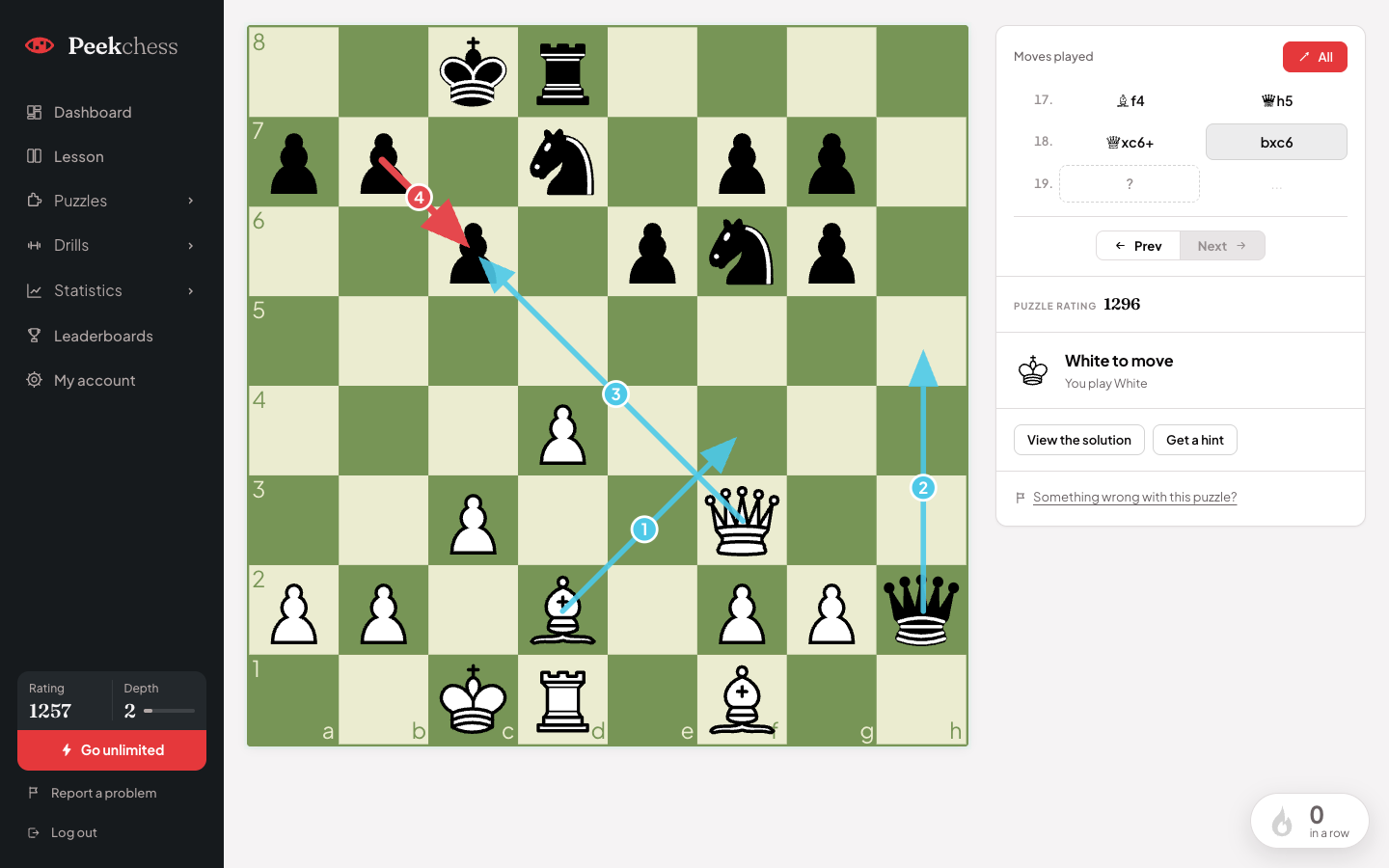
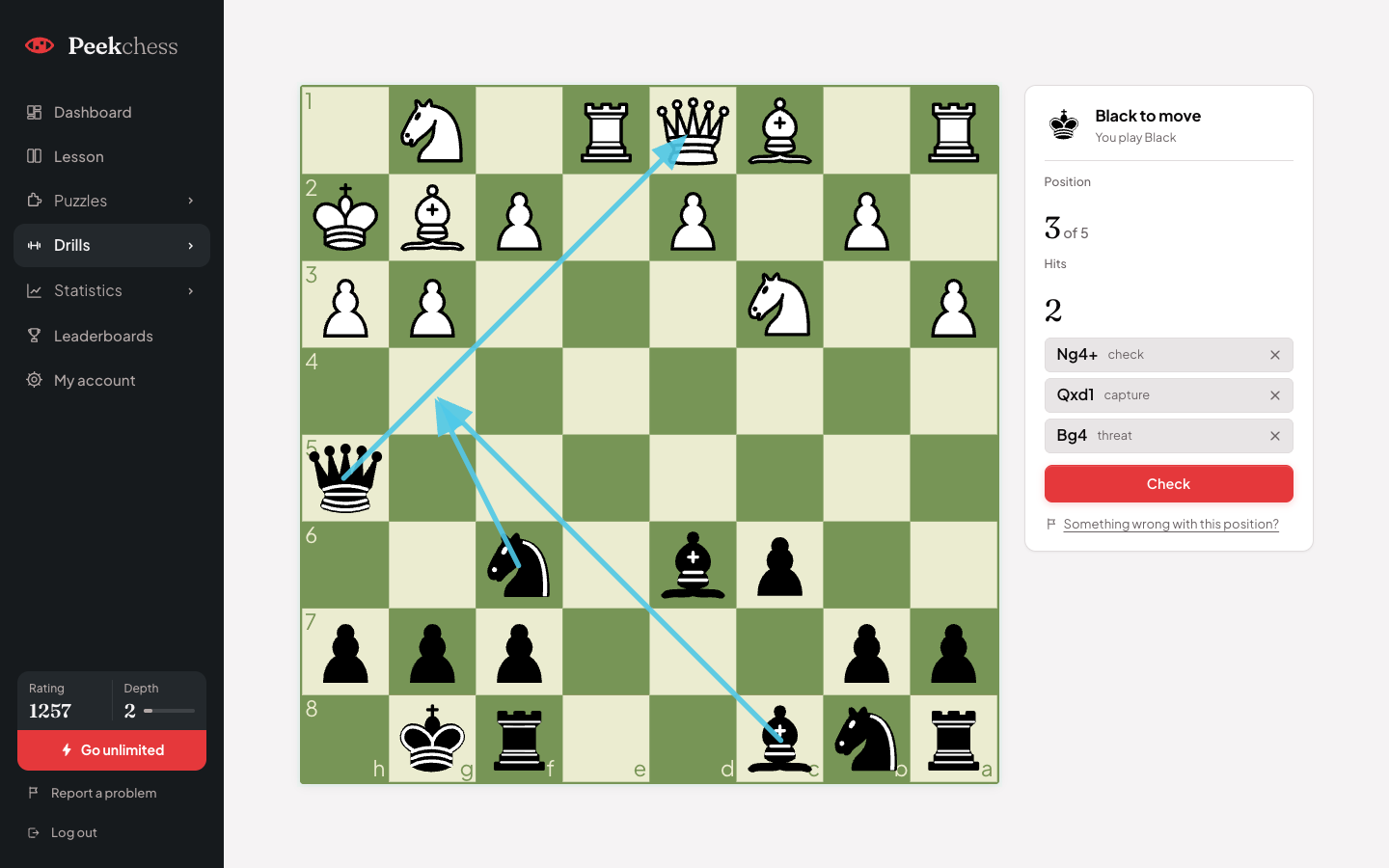
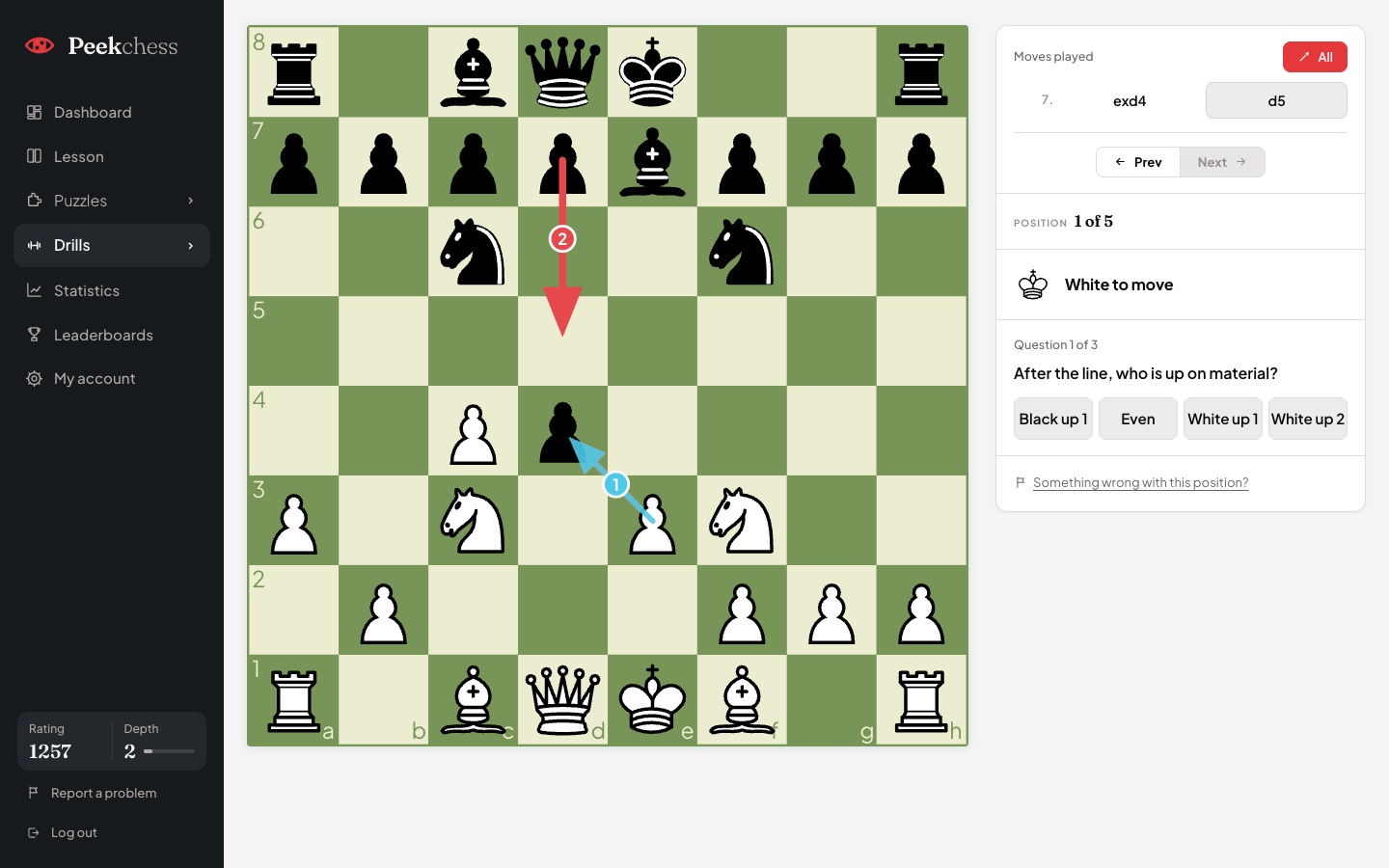
This step is what Peekchess puzzles are built for. The board stays still while you solve and the pieces never move. Each move is checked as you play it and each move is drawn as an arrow, so you have to hold the new position in your head and find your next move from there. One wrong move ends the puzzle, which means guessing doesn't get you anywhere. You also set how deep the lines go, so you can start short and add a move once it feels easy.
Do you need a special opening while your calculation is one move deep?
No. Someone on Reddit asked exactly this, and most of the replies told them to learn ideas rather than lines. Bring your pieces out, castle early, fight for the center, and don't move the same piece twice without a good reason. The games we counted point the same way. Under 1200, the opening decided 1 of every 100 lost games, and by the opening I mean a slow loss by move 15 with no big mistake. Tactics decided 73.
That doesn't mean the early game is safe. Under 1200, half of all losses were decided in the first 15 moves, mostly by tactics. So the early game clearly matters, but what loses it is a missed capture rather than a missing line of theory, and that's why the routine starts from move one. The full study has the numbers for every rating band.
If you're still choosing where to solve puzzles, here are the best chess puzzle apps in 2026.
Read next. How many moves ahead do chess players think? Chess calculation by rating, Chess puzzles for beginners to start calculating and Can adults still improve their chess calculation?.
How many moves ahead should I think in chess?
As a beginner, one move for each side on every move, meaning your move and your opponent's best reply. In our count of lost games under 1200, more than half of the tactic losses were punished right away, in 1 move (2 plies). Go further only when the line is made of checks and captures.
How do you see moves ahead in chess?
Stop trying to guess your opponent's move. Before you play, look at the board from their side and find every check, capture and threat they would have. Pick the one that hurts you most and make sure you have an answer to it.
Why can I only see one move ahead?
Usually because you're trying to predict the game. Calculation only needs to check the forcing replies, the checks, captures and threats. That's a short list, and with practice you get through it quickly.
Is it normal to only think one move ahead at 500?
Yes, most players start there. The first step isn't seeing far, it's checking your opponent's reply before every move you play. Under 1200 in our study, 56 of 100 punishing moves were plain captures, which is exactly the kind of move that check finds.
What is the best way to practice calculation as a beginner?
Short puzzles, solved in your head before you move a piece. Start with mate in one, mate in two, free pieces and simple forks. Ten puzzles solved properly will teach you more than fifty you guessed.