Does the Woodpecker Method train calculation?

The Woodpecker Method is a way of training chess tactics through repetition. You solve a fixed set of puzzles, and then you solve the same set again and again, a little faster each time. It takes its name from the book The Woodpecker Method by grandmasters Axel Smith and Hans Tikkanen, published by Quality Chess in 2018. As a way to train recognition it works well. What it leaves out is calculation, by which I mean finding the line in a position you have never seen before.
How the Woodpecker Method works, and why each round needs less calculation
- 1Pick a fixed set of puzzles. The book has over 1,100 of them, from beginner level up to advanced. Once you start, the set stays the same.
- 2Solve the whole set once. Calculate each line properly, then check the answer.
- 3Go back to the first puzzle. The same puzzles, in the same order.
- 4Repeat, faster each time. After a few rounds you know a lot of the positions before you've calculated anything.
So every round asks for less calculation than the one before. In the first round you calculate every line. Later on you mostly remember the answer, and that's exactly why you get faster. I'm only describing the idea here, so if you want to follow the method to the letter, follow the book.
Does the Woodpecker Method train recognition or calculation?
Recognition, more than calculation. A big part of chess skill is seeing a pattern you've met before, like a back-rank mate, a knight fork or a queen sacrifice that ends in a smothered mate. The first time you meet one of these, you have to calculate it. Once you've solved it several times, you simply see it.
And that matters, because tactics decide most games. In our study of 50,000 games, 61 of every 100 losses came from a tactic, and only 2 were decided by the opening. A player who spots the common patterns quickly wins more of those moments and falls for fewer of them. Recognition also helps your calculation in a practical way, because it tells you which line to look at first.
What does it leave out? Calculating a line you have never seen
By the third time through a set, you aren't really calculating the puzzle any more. You're remembering it. That's the whole point of the method, and it's also its limit, because the one thing it stops training is calculating a line you have never seen.
In a game the position is always new. The pattern can get you to the right idea, but you still have to check your opponent's best reply, move by move, in your head, and nothing on the board moves while you do it. Recognition tells you where to look. Calculation tells you whether it actually works.
If you've solved thousands of puzzles and your rating hasn't moved, this is very often the gap. You know the patterns when you see them, but you don't calculate them through. Why puzzles don't show up in games goes into this in more detail.
Who is the Woodpecker Method for, and who needs calculation training?
- It suits you if you already know the basic patterns but find them too slowly, or miss them once the clock is running.
- You need calculation training if you see the idea and then get the moves wrong. More repetition won't fix that. New positions will, as long as you calculate each line to the end before you move.
- It's hard work. You solve the same puzzles many times over, so a small set you actually finish teaches you more than a big one you give up on.
Is Peekchess a Woodpecker Method app, or a calculation app?
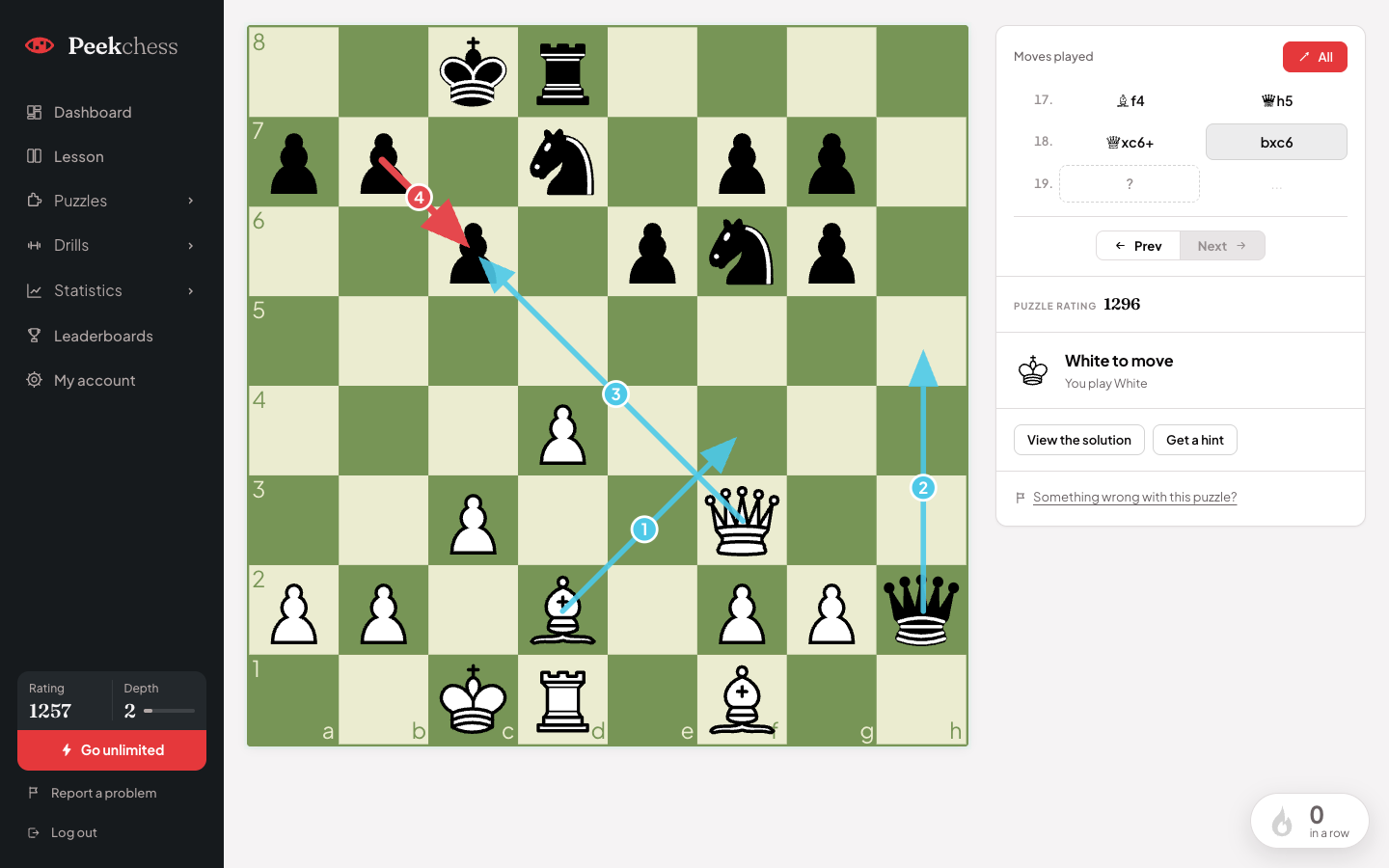
A calculation app. Peekchess is a chess puzzle app that trains calculation, and it isn't built around repetition, because you don't work through one fixed set again and again. The board stays still while you solve, so you calculate the whole line in your head first and then play it.
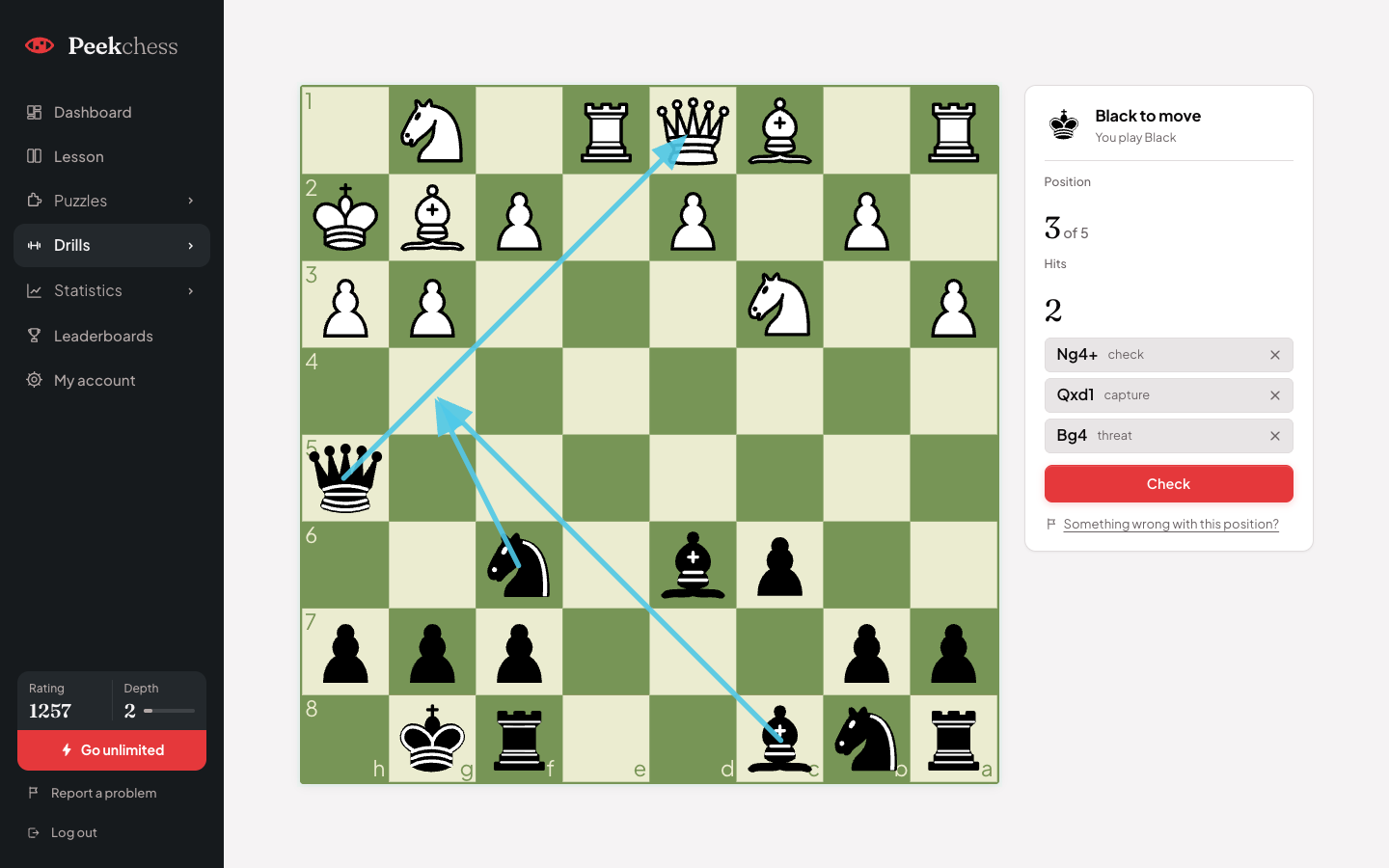
A Peekchess lesson is ten puzzles picked for you, some on your weak spots and some from the openings you play. I think the two kinds of training go well together, a fixed set for recognition and new puzzles for calculation. For the rest of a training plan, have a look at how to get better at chess.
If you're still choosing where to solve puzzles, here are the best chess puzzle apps in 2026.
Read next. Do chess puzzles train calculation or just pattern recognition?, Best Chessable Alternatives and Chess tactics puzzles for calculation.
What is the Woodpecker Method?
It's a way of training chess tactics through repetition. You solve a fixed set of puzzles, then solve the same set again and again, faster each time. It's named after the 2018 book by grandmasters Axel Smith and Hans Tikkanen, and it trains pattern recognition more than calculation.
Does the Woodpecker Method work?
It trains recognition, so after a few rounds you spot the patterns in your set quickly. It doesn't train calculating a position you have never seen, so it's worth pairing it with new puzzles.
How many puzzles are in The Woodpecker Method?
Over 1,100, from beginner level up to advanced, according to the book's listing.
Is the Woodpecker Method good for beginners?
The book's puzzles start at beginner level. If you're still learning the basic patterns, like forks, pins and back-rank mates, learn those first and then repeat a small set. Solve new puzzles alongside it to train your calculation.