Do chess puzzles train calculation or just pattern recognition?

Chess puzzles can train two different skills, pattern recognition and calculation, and which one you actually train depends on how you solve them. On most puzzle sites your opponent's reply is played on the board after each of your moves. That lets you solve one move at a time, and when a move looks right, you can simply try it and see what happens. That's recognition. Calculation is holding the whole line in your head while the board stays still, which is exactly what a game asks of you. Both skills matter, and any puzzle can train both.
What is the difference between pattern recognition and calculation?
Pattern recognition is seeing an idea you've met before. It might be a king with no escape squares, two loose pieces that a knight can hit at once, or a queen standing on the same line as the king. You don't work these out, you just see them, often within a second or two.
Calculation is the next part, checking whether the idea actually works in this position. You play the moves in your head, find your opponent's best reply to each one, and see where the line ends up. Nothing on the board moves while you do it.
In a real game the two work together. Recognition gives you a short list of moves worth looking at, and calculation checks them. If you have the patterns but not the calculation, you end up playing sacrifices that almost work. If you have the calculation but not the patterns, you have too many moves to check and you run short of time.
Why do most chess puzzles train recognition more than calculation?
On most puzzle sites the pieces move as you solve. You play a move, the site accepts it, and your opponent's reply appears on the board, so now you're looking at a new position with a smaller puzzle in it.
In practice, a three-move combination becomes three one-move puzzles. You never have to picture the position after the reply, because the board shows it to you. And when you're not sure, you can play whatever looks most forcing and let the board tell you whether it worked. Plenty of players admit to this on chess forums, including strong ones. They guess their way into the right sequence, and the site still counts the puzzle as solved.
That doesn't make those puzzles useless. Every puzzle you solve adds a pattern to your memory, and patterns win games. What it does mean is that your puzzle rating can climb mostly on recognition, while the part a game really tests, seeing the whole line before you move, gets much less practice. Timed modes, where you race the clock, push this even further. There's no time to calculate there, so you play whatever you recognize.
Does pattern recognition matter as much as calculation?
It does, and our own numbers show why you need both. We went through 50,000 rapid and classical Lichess games, and 61 of every 100 losses came from a tactic, while only 2 came from the opening.
We also looked at the first move of the line that punished each losing mistake, and in 96 of 100 it was a check, a capture or a threat.
| Rating band | Check | Capture | Threat | Quiet move |
|---|---|---|---|---|
| Under 1200 | 32 | 56 | 10 | 2 |
| 1200 to 1499 | 33 | 51 | 14 | 2 |
| 1500 to 1799 | 32 | 47 | 17 | 4 |
| 1800 to 2099 | 31 | 42 | 22 | 5 |
| 2100+ | 30 | 39 | 24 | 7 |
| All games | 32 | 48 | 16 | 4 |
That point goes to recognition. The lines that decide games nearly always start with a move you already know to look for, and pattern training teaches you to spot those moves quickly, for your opponent as well as for yourself.
But the first move is only where the line begins. Under 1200, 43 of 100 tactic losses needed 2 moves or more (4 plies) to be punished, and at 2100 and up, 74 did. So the stronger your opponents get, the further ahead you have to see, and the quieter that first move tends to be. At 2100 and up, 24 of 100 punishing lines started with a threat rather than a check or a capture.
I should be clear about one limit here. The study counted losses to tactics, not to calculation, so it can't tell you whether a player missed the idea or misjudged the line. Either way the fix looks the same, with recognition finding the check, capture or threat and calculation following it to the end. The full study has the method and the numbers for each rating band.
How can you tell if your puzzles train calculation or only recognition?
- Your puzzle rating climbs and your game rating doesn't. The tactics you solve online don't show up in your games, or they show up a move too late. That's the calculation gap behind a rating plateau.
- You know your first move but not their reply. If you couldn't say what your opponent will play back before you make your move, the board is doing that part for you.
- You solve fast and miss often. A first move you played in two seconds that turned out wrong was a guess.
- Endgame and quiet-move puzzles feel much harder. A pawn race gives you very few patterns to lean on, so you have to count every move. Many players say their results on those themes are well below their usual puzzle rating.
If most of these sound familiar, your puzzles are mainly training recognition. That isn't wasted work at all. You just need to add the other half.
How do you make any puzzle site train calculation?
You don't need a new site for this, you need to change the way you solve. If you ask on a chess forum how to get more out of puzzles, the same advice keeps coming back from players at every level.
- 1Say the whole line before you touch a piece. Your move, their best reply, your next move, all the way to the end. Only then play the first move.
- 2Don't move pieces to test an idea. That means no analysis board and no dragging a piece around to see what it hits. If you can't see it yet, keep looking.
- 3Check their other replies. The site only plays one defense. Before you move, ask yourself what else they could do, starting with their checks and captures.
- 4Count a wrong line as a miss. If the reply on the board isn't the one you planned for, treat the puzzle as missed, even when the site marks it as solved.
- 5Solve harder puzzles, and take your time. Pick puzzles a little above your rating and turn the clock off. A hard one deserves five or ten minutes. For the hardest ones, write the line down first, then play it out and compare.
You'll solve fewer puzzles a day this way, and that's fine. Ten puzzles calculated to the end do more for your calculation than fifty you clicked through. For choosing which moves to calculate and deciding where a line ends, the four steps in how to calculate in chess will help.
One more thing changes the balance. Solving the same set of puzzles over and over, which is what the Woodpecker Method asks you to do, builds recognition on purpose. It's new positions that make you calculate.
Is there a puzzle app that forces calculation of the whole line?
A puzzle book already does it, as long as you solve from the diagram, because a diagram can't move. Peekchess does the same thing in an app, and it came from work I was doing by hand with my students for years before the app existed.
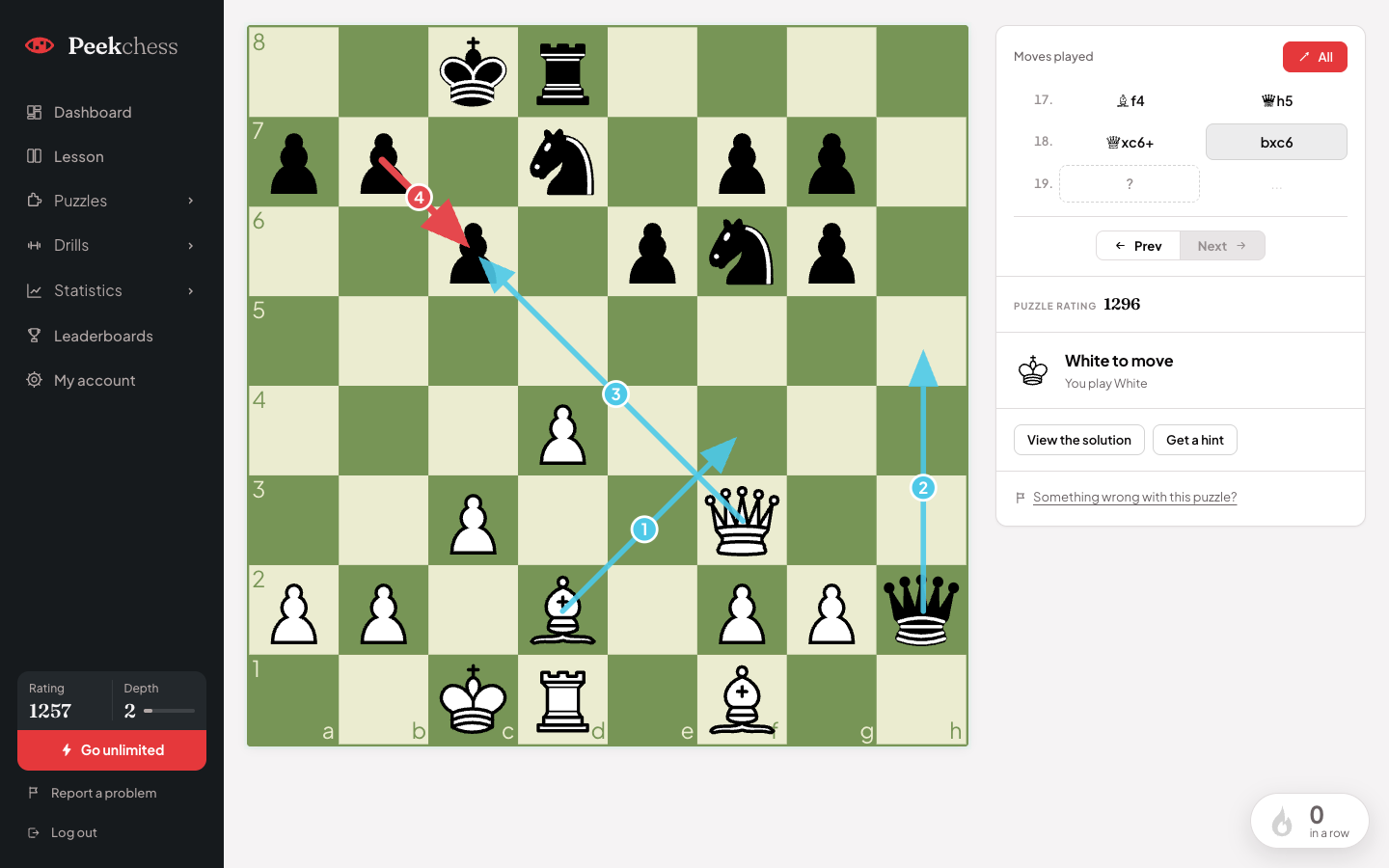
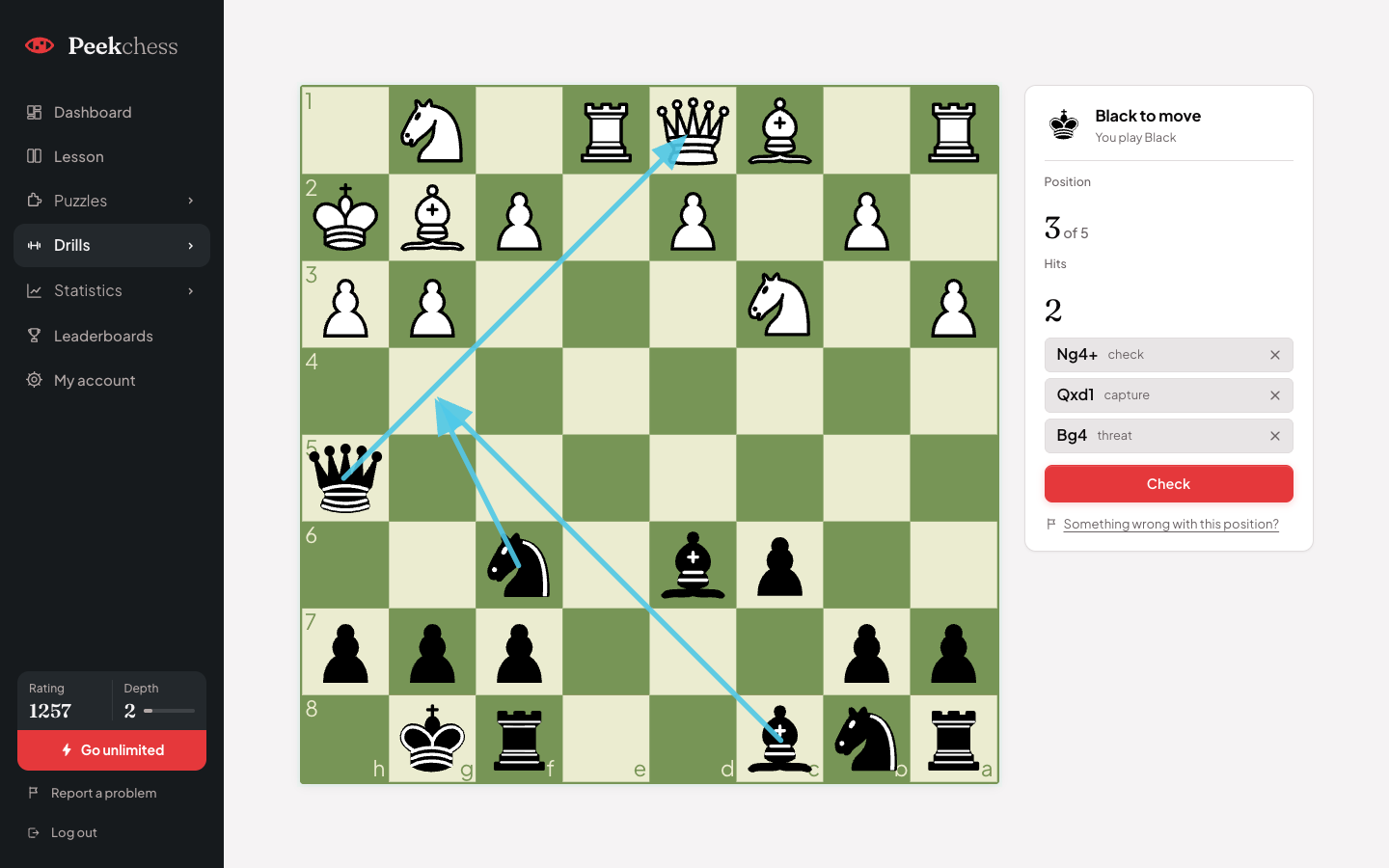
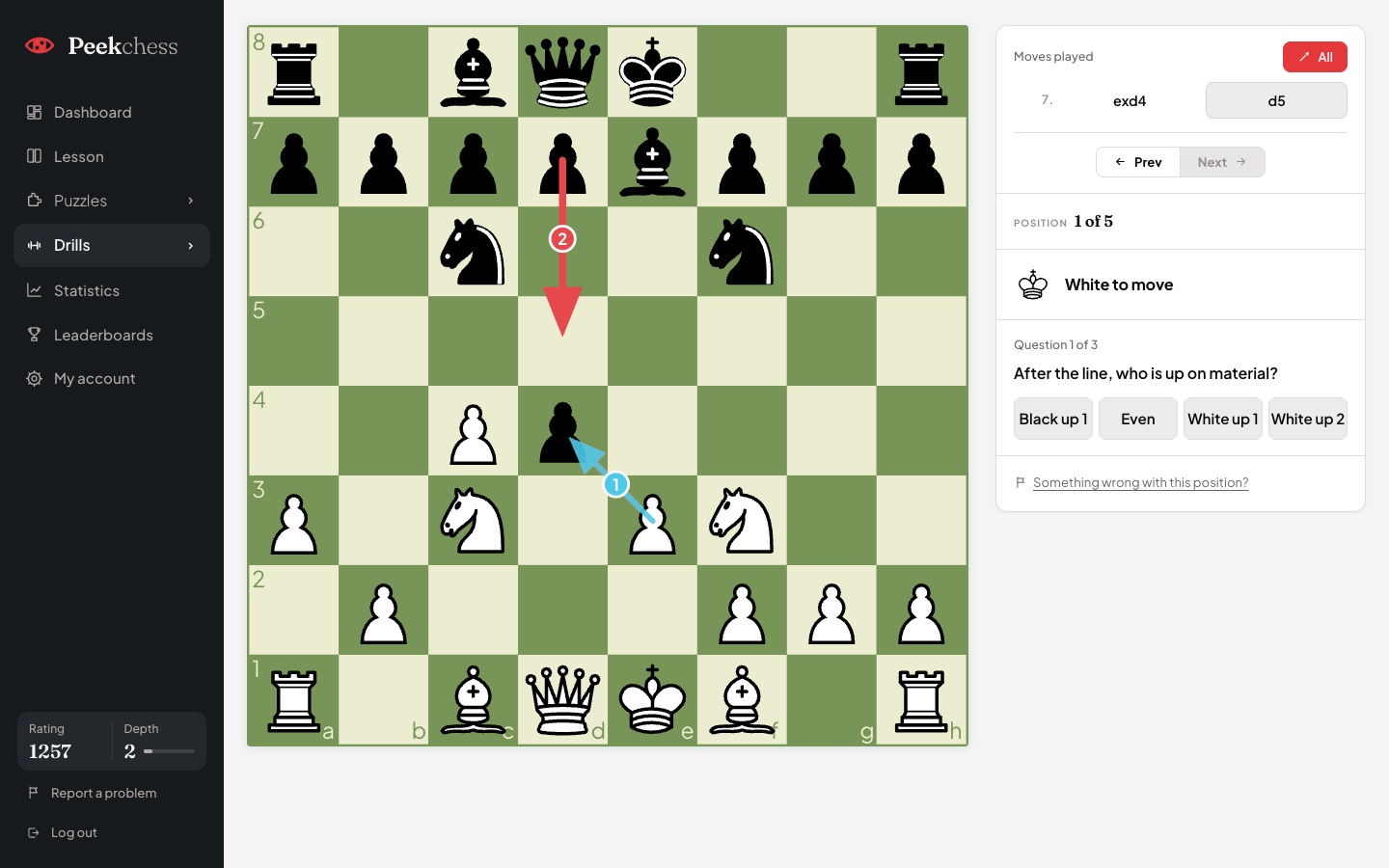
The board stays still from the first move to the last. The puzzle's first moves arrive as arrows, and then you play every move of the winning line yourself, from the position in your head. Each correct move is confirmed and each move is drawn as an arrow, but the pieces don't move, so you never get to look at the new position. One wrong move ends the puzzle and shows you the answer, so there's no guessing and trying again.
You can set how many moves ahead you work, and the depth also climbs as you solve. It's slower than a site where the pieces move, and that's the trade you're making. If you want volume for patterns, a site like that is still worth using alongside it. There's more on how the method works.
Read next. Does the Woodpecker Method train calculation?, Chess Puzzles Where the Pieces Don't Move and Chess rating plateau? Why your puzzles skip the calculation.
Do chess puzzles improve calculation?
They can. They train calculation when you work out the whole line, including your opponent's best reply to each move, before you move a piece. If you solve them one move at a time while the board shows each reply, they mostly train pattern recognition.
Are chess puzzles just pattern recognition?
The way most sites run them, mostly yes. The pattern finds the first move and the board shows you the rest. If you say the whole line before you move, the same puzzle trains calculation as well.
How do I practice calculation with puzzles?
Pick puzzles a little above your level, turn off the clock, and say the whole line, with your opponent's best reply to each move, before you touch a piece. Don't move pieces to test ideas, and if the reply on the board isn't the one you expected, count the puzzle as a miss.
Is there a puzzle app that makes you calculate the whole line?
Yes. In Peekchess the board stays still while you solve. The puzzle's first moves land as arrows, so you start from a position you're holding in your head, and then you play every move of the winning line yourself. Each move is checked as you play it, each move is drawn as an arrow, and one wrong move ends the puzzle.
Should I do lots of easy puzzles or a few hard ones?
Both have their place. Lots of easy puzzles build recognition, and a few hard ones solved slowly in your head build calculation. If your puzzle rating keeps climbing but your games don't, do fewer and calculate each one to the end.