How many moves ahead do chess players think?Chess calculation by rating

There's no single number. Strong players calculate a long way when the moves are forcing and a short way when they aren't, and they stop as soon as they know a line works. What we can measure is how far ahead you needed to see. In our study of 50,000 rapid and classical Lichess games, under 1200, 43 of every 100 tactic losses needed 2 moves (4 plies) or more to see coming. At 2100 and up, 74 did.
So the higher the rating, the further ahead you need to see. Below is the data by rating band, what it can't tell you, and how to stretch your own calculation.
How far ahead did calculation need to go at each rating?
We took 10,000 lost games in each of five rating bands, with both players rated inside the band. For every game lost to a tactic, we counted how many moves it took before the losing move was punished. A move here means one move by each side, so 1 move is 2 plies. 1 move (2 plies) means it was punished straight away. You moved, and they took.
| Rating band | 1 move (2 plies) | 2 moves (4 plies) | 3 moves (6 plies) | 4 moves (8 plies) | 5 moves (10 plies) |
|---|---|---|---|---|---|
| Under 1200 | 42 | 18 | 7 | 4 | 2 |
| 1200 to 1499 | 32 | 19 | 9 | 4 | 3 |
| 1500 to 1799 | 24 | 20 | 9 | 5 | 3 |
| 1800 to 2099 | 18 | 18 | 10 | 6 | 4 |
| 2100+ | 13 | 15 | 10 | 7 | 4 |
| All games | 26 | 18 | 9 | 5 | 3 |
Look at the first column. Under 1200, 42 of every 100 lost games were a tactic punished on the very next move. Often that's a piece left where it can be taken, or a check that wins something. At 2100 and up, only 13 of 100 were. Strong players rarely leave that kind of loss on the board, so the tactics that beat them tend to run longer.
If you count only the tactic losses, the pattern is clear. The share that needed 2 moves (4 plies) or more goes up with every band, from 43 of 100 under 1200 to 74 at 2100 and up.
What does this data say about calculation, and what doesn't it?
It measures the line that punished the losing move. It doesn't measure how far either player actually calculated. Someone who lost to a 2-move (4-ply) tactic may well have calculated much deeper in another line and simply never looked at this one. So read the table as how far ahead you needed to see to avoid that loss, not as how far players at that level see.
- The tactic test looked at most 5 moves (10 plies) ahead. Anything longer was counted as a different kind of loss, which is why the table stops there.
- The games are rapid and classical Lichess games from August 2026, and only the ones that had a computer analysis.
- Every band has the same number of games, so the All games row weighs every band equally.
The full method and its limits are in the 50,000-game study.
Why is calculation deep in forcing lines and short everywhere else?
If you ask players on Reddit how far ahead they calculate, the top answers keep coming back to the same thing. It depends on the position. When every move is a check or a capture, your opponent has only one or two replies, so you can follow the line a long way. In a quiet position they have many replies, each of those branches out again, and nobody calculates very far.
Players also stop once they know a line works. In one thread about a position with a long forced mate, the most upvoted answer said a top player wouldn't calculate the mate at all. They would see that the first move wins and just play it. Knowing when to stop calculating is part of the skill.
Our data agrees with them. We looked at the first move of every line that punished a losing mistake, and in 96 of 100 it was a check, a capture or a threat.
| Rating band | Check | Capture | Threat | Quiet move |
|---|---|---|---|---|
| Under 1200 | 32 | 56 | 10 | 2 |
| 1200 to 1499 | 33 | 51 | 14 | 2 |
| 1500 to 1799 | 32 | 47 | 17 | 4 |
| 1800 to 2099 | 31 | 42 | 22 | 5 |
| 2100+ | 30 | 39 | 24 | 7 |
| All games | 32 | 48 | 16 | 4 |
Under 1200, 56 of 100 were plain captures. At 2100 and up, 24 of 100 were threats and 7 were quiet moves. The stronger your opponents get, the quieter the move you have to see coming. That's the case for selective calculation. Go deep where the moves are forcing, and keep it short where they aren't.
How many moves ahead do grandmasters think? Calculation without a fixed number
Nobody can honestly give you a single number, because it changes with every position. A grandmaster calculates selectively, like any good player, only more accurately. They pick a few candidate moves, follow the forcing ones until the checks, captures and threats run out, and then judge the position at the end.
In a pawn ending or a forcing attack, that can mean a very long line, because each side has so few choices. In a quiet middlegame it can be a short one, because judging the position well matters more than looking further. What sets strong players apart is less how far they look and more how rarely the line they settle on turns out to be wrong. They also know a lot of patterns already, so they don't spend time calculating what they can see at a glance.
How many moves ahead does a chess computer think? Engine calculation is different
An engine like Stockfish doesn't have a fixed number either. It searches a tree of moves, one level deeper at a time, for as long as you let it run. The depth you see on an analysis board counts plies, which are single moves by one side, not full moves.
The engine also goes further down the lines that matter, such as checks, captures and the main line, and drops lines that look bad early on. So the depth on the screen is a setting, not a skill level, and you can't really compare it with a person. You calculate a handful of lines, while an engine checks far more positions than any person could.
How many moves ahead should you think? A calculation habit for every move
Start with 1 move (2 plies), every time it's your turn. Before you play, ask what your opponent can do next, meaning their checks, captures and threats. Under 1200, that first column alone was 42 of every 100 lost games.
Then, whenever there's a forcing move on the board, keep going until the forcing moves run out. That's how you find the 2-move (4-ply) and 3-move (6-ply) tactics, and those decide more and more games as your rating climbs. At 2100 and up, 74 of 100 tactic losses needed 2 moves (4 plies) or more.
Time is rarely why a tactic gets missed. In 95 of 100 tactic losses the loser still had at least a minute on the clock, and the losing move typically took 11 seconds. Most of the time, the calculation simply stopped too early.
How do you see more moves ahead? Train your calculation step by step
- 1List the forcing moves first. Checks, captures and threats, for both sides. In our games they started 96 of 100 punishing lines.
- 2Follow one line to the end. Play it in your head until there are no more checks, captures or threats, then judge the position.
- 3Check your opponent's best reply. Not the reply you're hoping for. A line built on a hopeful reply isn't really calculation.
- 4Go 1 move (2 plies) deeper than feels necessary. If you stopped at their reply, add your next move and theirs.
- 5Practice with the board still. Solve puzzles without moving the pieces until you've seen the whole line.
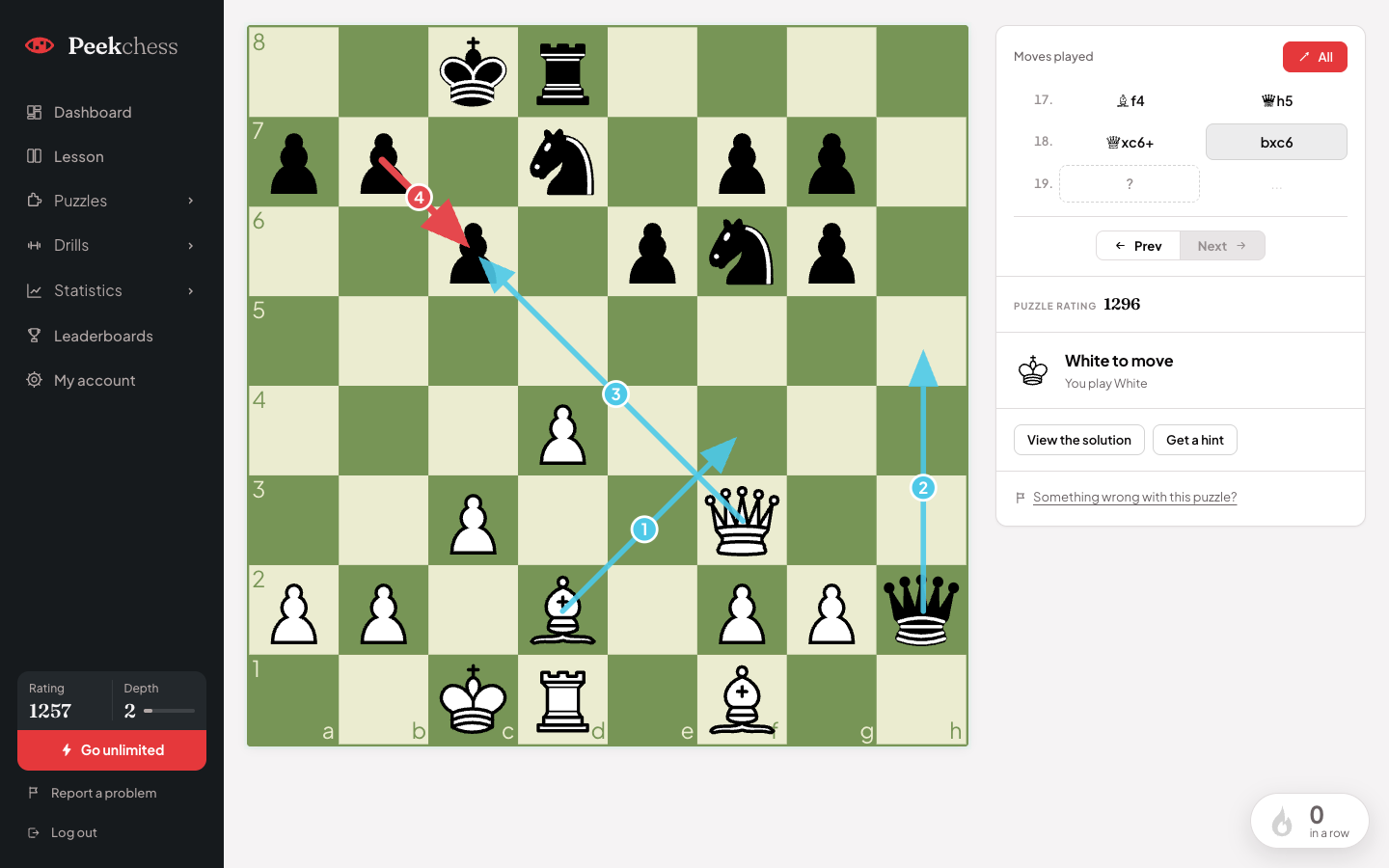
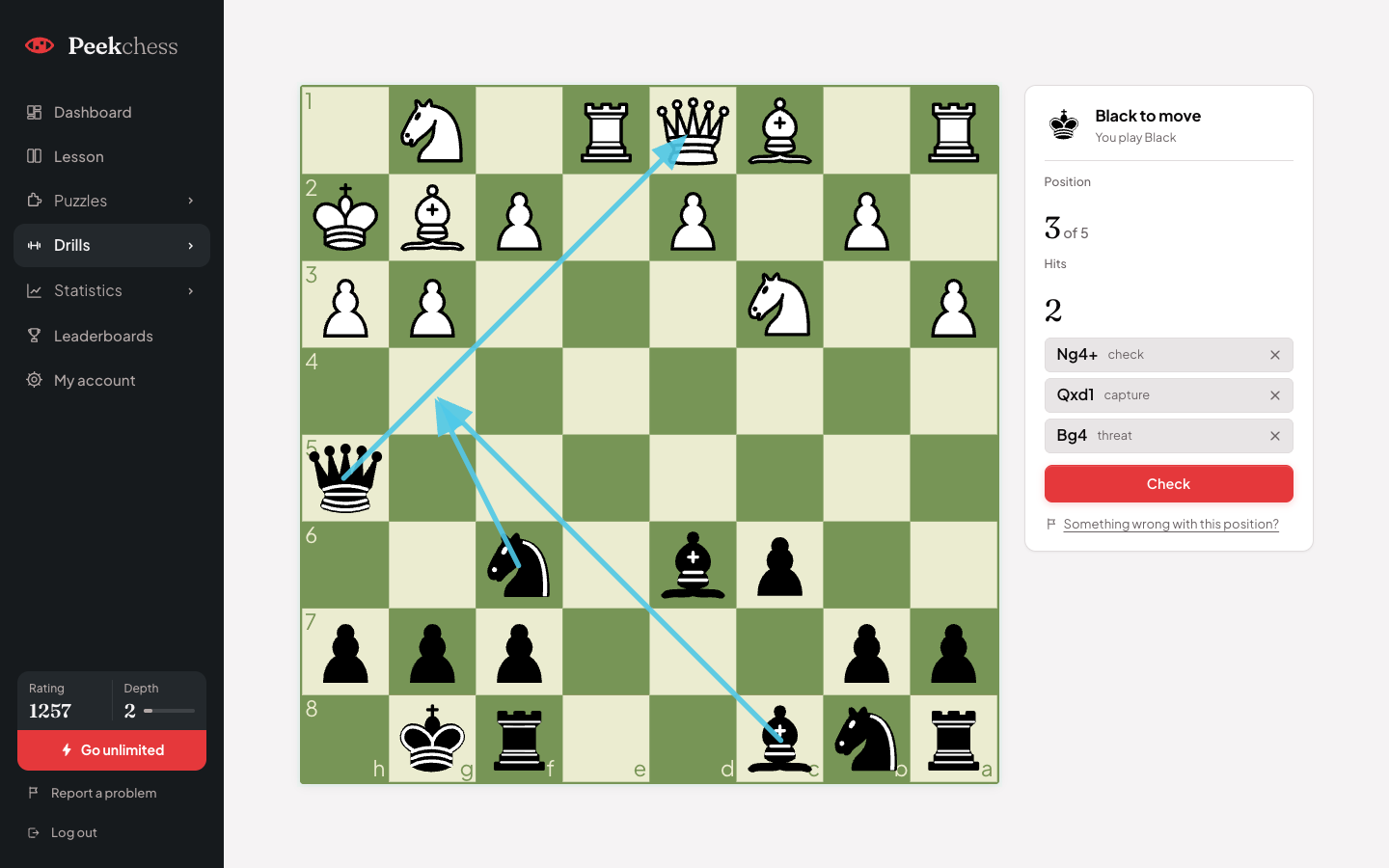
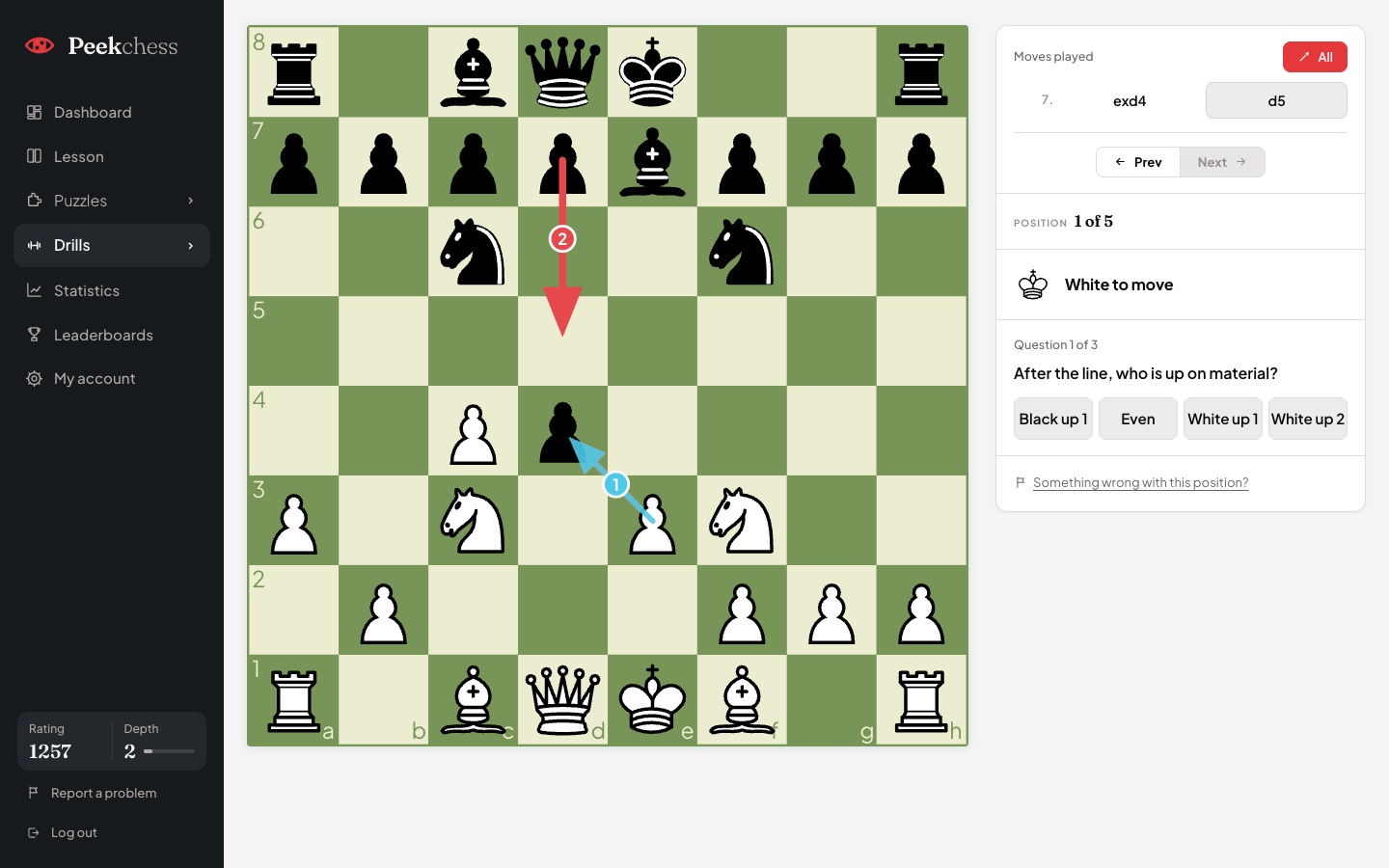
The four steps in how to calculate in chess go into each part of this. Peekchess is built for the last step. The board stays still, the first moves land as arrows, and you find the win in your head, at a depth you set. Its Forcing moves drill trains the first step, where you pick up to three checks, captures or threats you would calculate.
If you're still choosing where to solve puzzles, here are the best chess puzzle apps in 2026.
Read next. Chess calculation for beginners, When to stop calculating in chess and Do tactics matter more than openings? 50,000 games.
How many moves ahead do average chess players think?
There's no fixed number, and it changes with the position. What we measured is how far ahead players needed to see. In 50,000 Lichess games, under 1200, 43 of 100 tactic losses needed 2 moves (4 plies) or more to see coming. At 2100 and up, 74 did.
How many moves ahead do grandmasters think?
It depends on the position. Grandmasters calculate selectively. They follow forcing lines with checks, captures and threats a long way and quiet lines a short way, and they stop once they know a line works. Any single number you hear is a guess.
How many moves ahead does Stockfish see?
It depends on how long it runs. An engine searches one level deeper at a time, goes further on forcing lines and the main line, and drops lines that look bad. The depth an analysis board shows counts plies, which are single moves by one side, not full moves.
How many moves ahead should I think in chess?
At least 1 move (2 plies) on every move, which means looking at your opponent's checks, captures and threats. When there's a forcing move on the board, keep going until the forcing moves run out. Under 1200, 42 of every 100 lost games were a tactic punished on the very next move.
How do I learn to see more moves ahead in chess?
Look at the forcing moves first, follow one line to the end in your head, check your opponent's best reply, and practice on puzzles where the pieces don't move until you've seen the whole line.