Chess strategies for beginners, 10 rules that win games

Ask for chess strategies for beginners and you'll hear the same rules almost everywhere. Control the centre, develop your knights and bishops, castle early, don't bring the queen out too soon. They're good rules, and they've lasted because they work. The trouble is that a rule on its own doesn't tell you very much. You need to know why it works, so you can tell when it applies, and you need to know what usually goes wrong when beginners try to follow it.
So that's how I'll go through them. Ten strategies, roughly in the order you meet them in a game, from the first move to the endgame. For each one I'll explain what it means and why it works, the mistake beginners make with it, and a position that shows it. Three of those positions are puzzles you can solve on the board.
What is chess strategy?
Strategy is the long-term side of chess. It's where your pieces belong, which pawn moves help you and which ones hurt, when to trade and when to keep pieces on the board. It doesn't need exact moves. For a beginner it mostly comes as rules of thumb, like knights before bishops, or castle before you attack.
Tactics are the short-term side. They're forcing sequences of a few moves that win something straight away, a fork, a pin, a mate in two. The two belong together. Good strategy gets you positions where the tactics work for you, and one missed tactic can undo a whole game of good strategy. That's why one of the ten rules below isn't really strategy at all, but a habit you need before every move.
1. Control the centre
The four squares in the middle, d4, e4, d5 and e5, are the most valuable on the board. A piece in the centre reaches more squares and can switch quickly from one side to the other. A knight on e4 attacks eight squares, a knight in the corner only two. That's why the most popular first moves, 1.e4, 1.d4 and 1.Nf3, either put a pawn in the centre or aim a piece at it.
Control doesn't only mean standing there. A knight on f3 controls d4 and e5 without being on either, and a bishop on the long diagonal can control the centre from the corner. Where beginners go wrong is pushing pawns into the middle without counting. If your opponent attacks a central pawn more times than you defend it, you lose it. The opposite mistake is just as common, starting with moves like 1.a4 or 1.h4 that do nothing for the centre at all.
Here's the simplest example, from the most common opening there is.
2. Develop your knights and bishops
Developing means bringing your pieces off the back rank so they can take part in the game. Until they're out, they can't attack anything and they can't defend anything. The usual advice is knights before bishops, because you already know where a knight belongs, on f3 and c3 for White or f6 and c6 for Black, while the best square for a bishop depends on where the pawns end up.
In the opening, try to bring out a new piece with every move, and don't move the same piece twice without a good reason. Knight to f3, then g5, then back to f3, and your opponent has developed two pieces in the meantime. The good reasons are about material. If the piece is attacked, move it again. If a piece is hanging and taking it costs you a third knight move, take it, once you've checked what your opponent gets back.
Beginners usually go wrong in one of three ways. They play pawn moves like a3 and h3 instead of developing. They put a knight on the edge, where on a3 or h3 it reaches four squares instead of eight. Or they put a piece where a pawn can chase it, which costs the opponent nothing and costs them a move.
A clean example is the Italian Game, 1.e4 e5 2.Nf3 Nc6 3.Bc4 Bc5. Each side has moved one pawn and brought out two pieces, the knights towards the centre and the bishops onto open diagonals. White can already castle on the next move.
3. Don't bring your queen out too early
Your queen is your strongest piece, and in the opening that's exactly the problem. Every smaller piece can attack her, and every time one does, your opponent develops while you spend a move running away. Bring her out on move two and you can lose three or four moves like that. Wait until your knights and bishops are out and she has a safe square to go to.
Beginners get this wrong from both sides. The first mistake is bringing the queen out early to go for a quick mate, usually on f7. The second is the reverse. When the opponent brings their queen out, they attack her with the most natural developing move and forget to ask what she's threatening first.
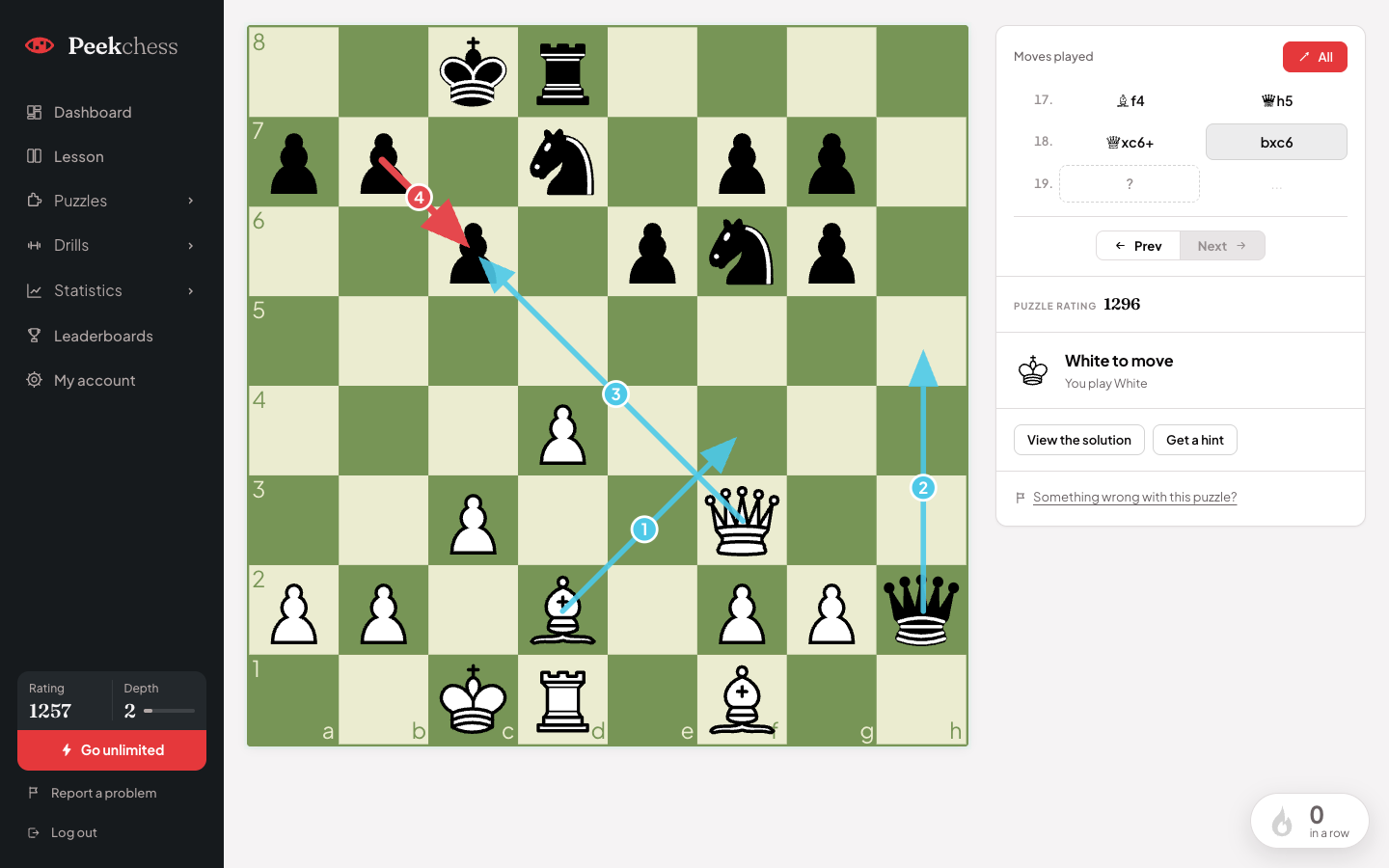
And here's what can happen to a queen that goes after pawns on her own. In this position from a real game, Black's queen has just taken the pawn on h2, while both black knights and the bishop on c8 are still at home. Find the move that leaves her trapped.
White to play. Find the winning move.
Show answer
1.Rh1 Qxh1+ 2.Bxh1. The queen on h2 has no safe square left.
4. Castle early
Castling does two jobs in one move. It takes your king away from the centre, where the files open first once pawns get exchanged, and it brings a rook towards the middle where it can be used. Most coaches tell beginners to castle within the first ten moves, which is a good target, and castling on the kingside is usually quicker because there are fewer pieces to move out of the way.
The rules are worth knowing exactly. You can't castle if your king or that rook has already moved, and you can't castle out of check, through a square your opponent attacks, or into check.
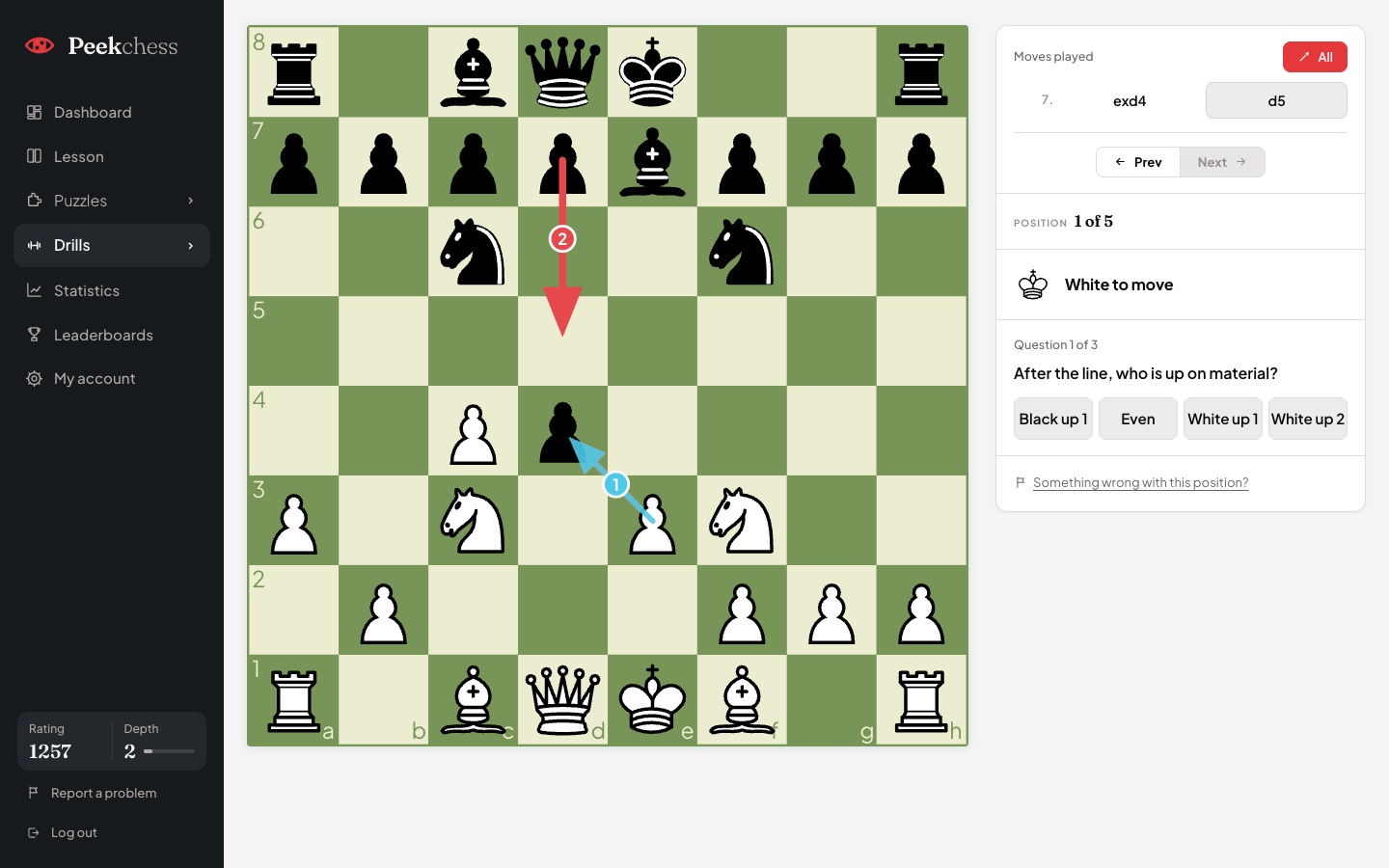
The usual mistake is leaving the king in the middle to grab a pawn or start an attack. While your king is still on e1 or e8, every check against it can also hit something else, and a loose piece is the easiest target there is. In this position from a real game, Black has just played ...d6, and that move opened the diagonal from a4 to the king.
White to play. Find the winning move.
Show answer
1.Qa4+ c6 2.Qxb4. The check also attacks the loose bishop on b4.
5. Connect your rooks and put them on open files
Once your knights and bishops are out and your king has castled, move the queen off the back rank and your rooks see each other. That's what connected rooks means, and it's a good sign your development is finished. Then a rook wants an open file, one with no pawns on it, because that's how it gets into the game. Two rooks doubled on an open file, or one rook on the seventh rank, can decide a game on their own.
Beginners tend to make two mistakes with rooks. They leave them in the corner all game, or they send them up the board and forget what the rook was doing at home. A rook on your back rank guards it. Take both rooks away while your king sits behind three unmoved pawns, and one check on the back rank can be mate. That's why strong players give the king a square, with a move like h3, once the position is calm.
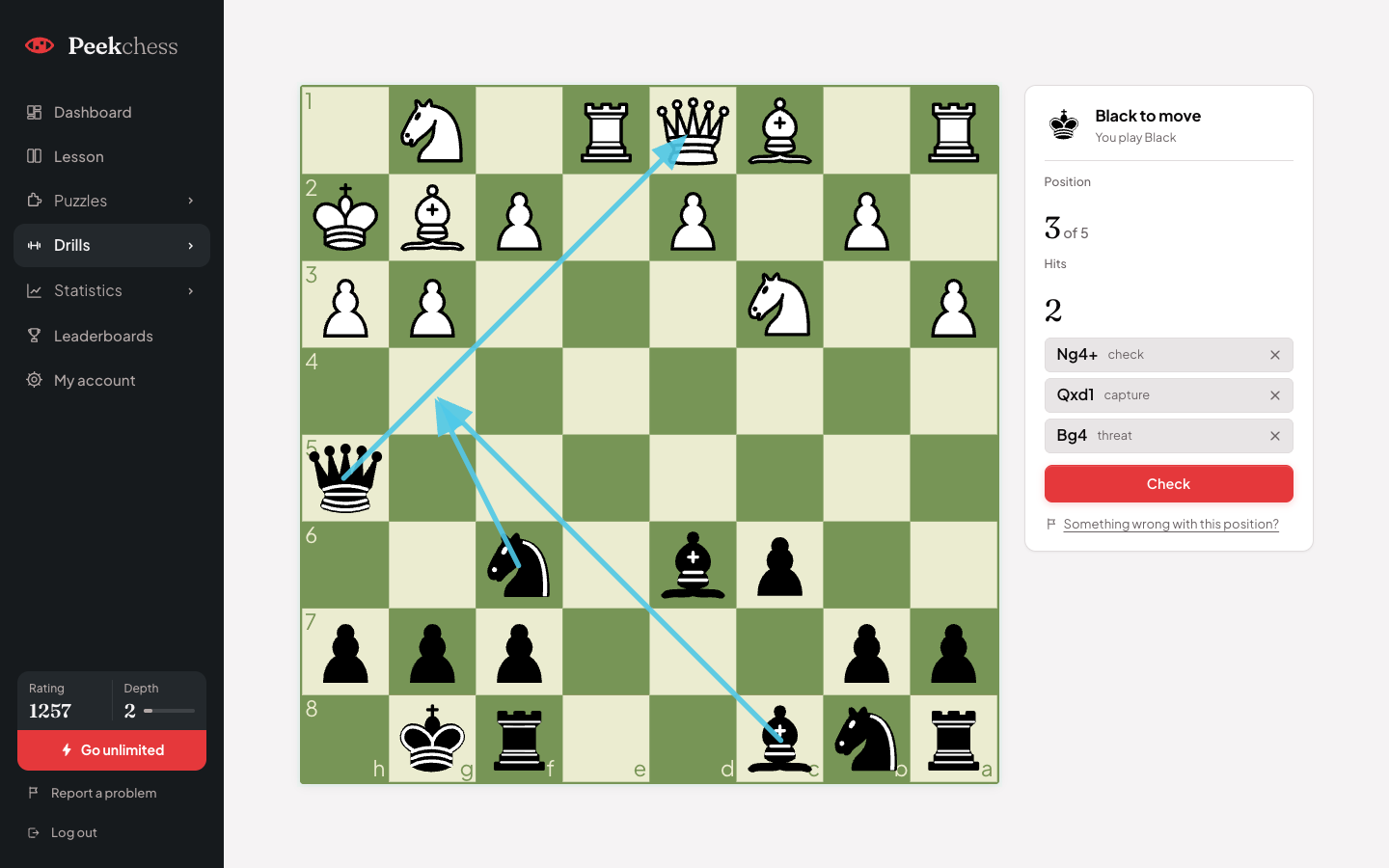
Here Black has a rook on the open d-file and has just taken a bishop on f5. One side has made room for its king, and the other hasn't.
White to play. Find the winning move.
Show answer
1.Qa8+ Rd8 2.Qxd8 mate. Black's king is shut in by its own pawns.
This is called a back-rank mate, and it's one of the first patterns worth knowing by heart.
6. Move pawns with a purpose
Pawns are the only pieces that can't go back. Every pawn move gives up control of some squares for good, and it can open a line towards your own king. So a pawn move needs a reason, like taking space in the centre, freeing a bishop, or giving your king a square, as h3 did in the last puzzle.
The pawn moves that hurt beginners most are the ones in front of their own king. Pushing the f- and g-pawns early opens diagonals to the king, and pushing the pawns in front of a castled king gives your opponent something to attack. The other habit to drop is pushing a pawn just to chase a piece. If the piece simply moves to a better square, all you've done is weaken your own position.
The most extreme example is the shortest game there is.
7. Before every move, look for your opponent's threats
This one isn't strategy in the usual sense, but none of the other nine work without it. Before every move, ask what your opponent's last move attacks, and then look at every check, capture and threat for both sides. It takes a few seconds.
It matters because of how beginner games are actually lost. We counted it. In 50,000 decisive rapid and classical games, 10,000 in each of five rating bands, 61 of every 100 losses came from a tactic and 2 from the opening. Under 1200 it was 73 to a tactic and 1 to the opening, and the move that punished the mistake was a plain capture 56 times in 100.
The usual mistake is to look only at your own plan, or to see that your opponent has left something to take and take it without asking why. There's an old trap that shows it well. After 1.e4 e5 2.Nf3 d6 3.Bc4 Bg4 4.Nc3 g6, White plays 5.Nxe5 and leaves the queen to be taken. 5...Bxd1 wins it, and 6.Bxf7+ Ke7 7.Nd5 is mate. That's Légal's Mate. Black took the most valuable piece on the board without asking what White was threatening, and the answer was mate in two.
What is a blunder in chess and three questions before every move go through this habit in more detail.
8. Trade pieces when you're ahead
Count material with the usual values. A pawn is worth 1, a knight or a bishop 3, a rook 5 and a queen 9. When you're ahead, trades help you, because your opponent has fewer pieces to make trouble with and your extra material counts for more as the board empties. When you're behind, avoid trades and keep pieces on, because you need them to make chances.
You can see it in the numbers. At the start each side has 39 points of material. A knight up with everything still on the board is 39 against 36, and your opponent still has plenty of pieces to attack with. Trade down to a knight and pawns against pawns, and the extra knight usually decides the game.
The mistake beginners make is trading without counting. Before you capture, count every capture on that square to the end, theirs and yours, and check that your recapture is safe. If the piece you plan to take back with is pinned, or it's the only defender of something else, the trade turns into a lost piece. The other mistake is trading your best piece for their worst one, like an active knight for a bishop that's stuck behind its own pawns.
9. Improve your worst piece
When there's no obvious plan, find your worst piece and make it better. It might be a knight on the edge of the board, a rook that hasn't moved all game, or a bishop stuck behind its own pawns. Put it on a square where it does something, and you've improved your position without giving anything away.
Say you're White and your pawns stand on d5 and e4. Both are on light squares, so your light-squared bishop is shut in behind them, which is what players call a bad bishop. Get it outside the pawn chain, where it has open diagonals, or trade it. A rook still on a1 when the d-file is open is an even simpler case. Rd1 puts it to work.
The mistake is playing a slow move like that while something forcing is going on. If your opponent threatens something, deal with it first. If you can win material by force, do that. When neither side has anything forcing, that's the moment to improve a piece.
10. Activate your king in the endgame
In the endgame the advice about the king turns round. With the queens and most of the pieces gone there's little danger of mate, and the king becomes a strong piece. Walk it to the centre, attack pawns with it and support your own. Make a passed pawn, one with no enemy pawn ahead of it on its own file or the files next to it, and push it. Put your rooks behind passed pawns, where they get stronger as the pawn moves up. And learn the two basic checkmates, king and queen against king and king and rook against king, so an extra piece turns into a win.
The mistake is keeping the king at home out of habit. In the middlegame that's right, but once the queens are off, a king on g1 is a piece doing nothing while the other king walks into the centre and starts eating pawns.
Endgames are also where you count moves. How many does my pawn need to promote, and how many does their king need to catch it? For a lone pawn against a king there's a shortcut, the rule of the square.
The ten chess strategies at a glance
Here are all ten again, with the mistake that goes with each one.
| Strategy | What it means | Common mistake |
|---|---|---|
| Control the centre | Aim pawns and pieces at d4, e4, d5, e5 | Pushing pawns you can't defend |
| Develop knights and bishops | A new piece out with each move | Pawn moves, knights on the edge |
| Keep the queen back | Bring her out after the minor pieces | Chasing an early mate |
| Castle early | King safe, rook towards the middle | Grabbing pawns with the king in the centre |
| Rooks on open files | Connect them, then find a file | No escape square on the back rank |
| Pawns with a purpose | A reason for every pawn move | Pushing pawns in front of the king |
| Look for threats | Checks, captures and threats every move | Taking without asking why |
| Trade when ahead | Simplify with the extra material | Trading without counting |
| Improve your worst piece | Give the idle piece a job | Slow moves when something is forcing |
| Activate your king | Bring it to the centre in the endgame | Leaving it at home |
How to practise chess strategy as a beginner
Rules are easy to learn and hard to use, because in a game nobody tells you which rule a position is about. Three things help.
Play slower games. With ten or fifteen minutes each, you have time to think about where your pieces belong, and to look for threats before every move.
Go through the games you lose and find the move where it went wrong. Often it won't be a plan at all. It'll be a loose piece or a check you didn't see, and that's useful to know, because it tells you what to look for next time.
And solve puzzles. Most beginner games are decided by tactics, and puzzles are the quickest way to learn the patterns. Start with chess puzzles for beginners, then the chess tactics guide. Work out the whole line before you touch a piece, because in a game there's no second try. The calculation guide shows how, and how to get better at chess puts all of it into a plan.
That last habit, seeing the whole line before you move, is the one Peekchess is built around. It's a chess puzzle app that trains calculation, and it came out of work I'd been doing by hand with my students for years. In Peekchess the board stays still while you solve, so you see the moves in your head, the way you have to in a game.
If you're still choosing where to solve puzzles, here are the best chess puzzle apps in 2026.
Read next. Chess strategy, Chess puzzles for beginners to start calculating and Best app to learn chess.
What is the best chess strategy for beginners?
Control the centre, develop your knights and bishops, and castle early. Those three cover most of the opening. And before every move, check what your opponent threatens, because most beginner games are lost to a missed tactic, not a bad plan. In our count of 50,000 games, 61 of every 100 losses came from a tactic and only 2 from the opening.
What is the difference between strategy and tactics in chess?
Strategy is the long-term plan, where your pieces belong, which pawns to move and when to trade. Tactics are short forcing sequences that win something straight away, like a fork, a pin or a mate. Good strategy gets you positions where the tactics work for you, and one missed tactic can undo it in a single move.
What are the 3 C's in chess?
Usually control the centre, castle and connect your rooks, the three goals of the opening. Some coaches use a similar shorthand for checks, captures and threats, the forcing moves to look at before every move.
What is the 20-40-40 rule in chess?
A suggested split of study time, 20 percent on openings and 40 percent each on the middlegame and the endgame. It's a rule of thumb, not an official rule. For a beginner, much of the middlegame share should go on tactics, because that's what decides most games at that level.
How do you win chess in 4 moves?
With Scholar's Mate, 1.e4 e5 2.Bc4 Nc6 3.Qh5 Nf6 4.Qxf7 mate. It only works if your opponent misses the threat to f7. Anyone who sees it plays 3...g6 or 3...Qe7, and then the early queen just gets chased.
What is the best first move in chess for beginners?
1.e4 or 1.d4. Both put a pawn in the centre and open lines for a bishop and the queen. Many coaches start beginners with 1.e4, because the games open up quickly and there are more tactics to learn from.